









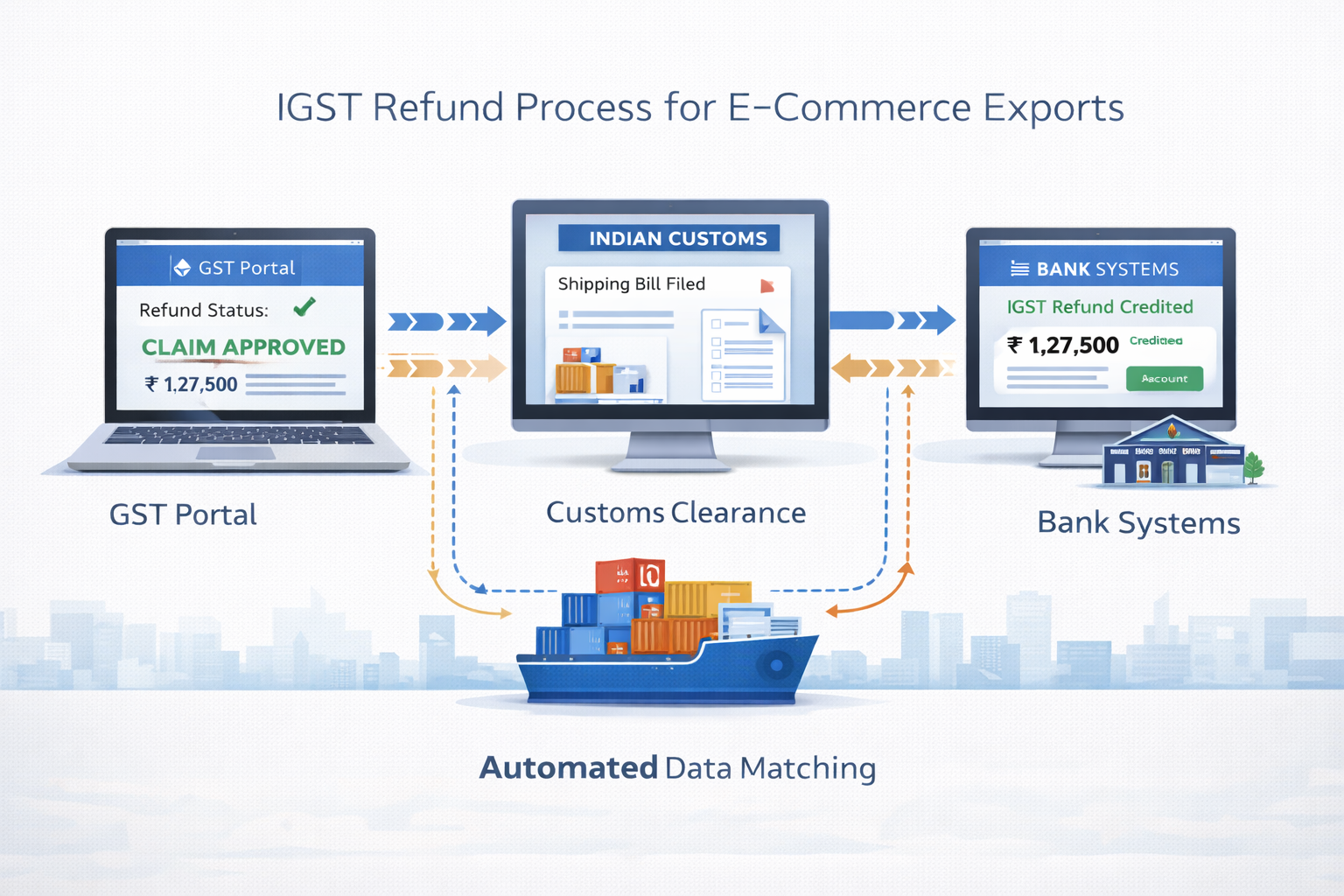
IGST Refund Process for E-Commerce Exports (Step-by-Step Guide)
For MSMEs and small exporters involved in e-commerce exports, the IGST refund plays a crucial role in maintaining healthy cash flow. Since exports are treated as zero-rated supplies, exporters are eligible to claim a refund of the Integrated Goods and Services Tax (IGST) paid on exported goods.
Understanding the IGST refund process step by step helps exporters avoid delays, errors, and working capital blockages—especially when supported by professional eCommerce management services that coordinate GST, customs, and banking compliance.
What Is IGST Refund in E-Commerce Exports?
When exporters ship goods outside India and pay IGST at the time of export, they are entitled to claim a refund of that tax once the goods are exported and export proceeds are realized.
The IGST refund mechanism is largely automated, provided exporters:
- Follow prescribed GST and customs procedures
- File accurate returns
- Ensure data consistency across systems
This automation works best when exporters adopt structured compliance workflows through end-to-end eCommerce management services.
Who Is Eligible for IGST Refund?
Exporters can claim IGST refund if:
- Goods are physically exported out of India
- IGST has been paid on exported goods
- Export documentation is correctly filed
- Export proceeds are realized within prescribed timelines
Both merchant exporters and MSMEs selling through e-commerce marketplaces are eligible, provided compliance requirements are met.
Step 1: Export Goods with IGST Payment
The IGST refund process begins at the time of export.
What Exporters Must Do
- Export goods on payment of IGST
- Declare correct GSTIN and invoice details
- Ensure product details are consistent across documents
The shipping bill filed during export acts as the refund application once all conditions are fulfilled.
Step 2: File Accurate Shipping Bill Details
Correct shipping bill filing is essential for refund processing.
Key Details That Must Match
- Export invoice number and date
- Exporter’s GSTIN
- IGST amount paid
- Port of export and shipping details
Any mismatch between shipping bill data and GST returns can delay or block the refund—an issue commonly addressed through expert eCommerce management services.
Step 3: File GSTR-1 with Export Details
Exporters must declare export transactions accurately in GSTR-1.
Important Points
- Export invoices must be reported correctly
- Shipping bill numbers and dates must be mentioned
- Invoice values and GSTIN must match shipping bill data
The GST system uses GSTR-1 to validate export transactions for IGST refunds.
Step 4: File GSTR-3B and Pay IGST
To remain eligible for a refund, exporters must:
- File GSTR-3B on time
- Pay IGST as declared
Refunds are processed only after the GST system confirms tax payment.
Step 5: Data Matching Between GST and Customs Systems
After returns are filed, automated systems perform data matching.
What Is Verified
- IGST payment confirmation
- Consistency between invoice and shipping bill details
- Export status confirmation by customs
If all data matches, the refund proceeds without manual intervention.
Step 6: Export Proceeds Realization and Bank Reporting
Export payments must be realized within prescribed timelines.
Why This Matters
- Banks report export proceeds through digital monitoring systems
- Refund eligibility depends on realization status
- Delays in payment realization can place refunds on hold
Tracking export proceeds proactively—often through eCommerce management services—helps avoid refund issues.
Step 7: Processing of IGST Refund by Authorities
Once all validations are complete:
- Refund is processed automatically
- No separate refund application is required
- Refund amount is calculated based on IGST paid
The approved refund is sent directly to the exporter’s registered bank account.
Step 8: Receipt of IGST Refund in Bank Account
After approval, the IGST refund is:
- Transferred electronically
- Credited to the bank account linked with GST registration
- Reflected in online refund status dashboards
Exporters should monitor refund status regularly to ensure timely receipt.
Common Reasons for IGST Refund Delays
Despite automation, refunds may be delayed due to:
- Mismatch between shipping bill and GST return data
- Incorrect GSTIN or invoice details
- Delayed or non-filing of GSTR-1 or GSTR-3B
- Pending export proceeds realization
- Incorrect or inactive bank account details
Regular reconciliation helps prevent these issues.
Best Practices to Ensure Faster IGST Refunds
Exporters can speed up refunds by following these practices:
- Maintain consistency across all export documents
- File GST returns within deadlines
- Verify shipping bill details carefully
- Track export payments and coordinate with banks
- Maintain accurate records for audits or queries
A disciplined compliance approach—often managed through eCommerce management services—minimizes refund delays.
IGST Refund and E-Commerce Exports
For e-commerce exporters, IGST refunds are vital for liquidity.
Why It Matters
- Prevents working capital blockage
- Improves international pricing competitiveness
- Supports sustainable export growth
Exporters selling through marketplaces must ensure coordination between platform invoices, GST filings, and export documentation.
Conclusion
The IGST refund process for e-commerce exports is designed to be automated and exporter-friendly, provided compliance requirements are met. By following the step-by-step process—from accurate shipping bill filing to timely GST returns and export proceeds realization—MSMEs can ensure smooth and timely refunds.
Managing IGST refunds is not just a compliance obligation; it is a financial strategy that improves cash flow, reduces costs, and supports scalable global growth. With structured processes and support from professional eCommerce management services, exporters can navigate the refund process confidently and efficiently.
![[object Object]](/_next/image?url=https%3A%2F%2Fcms.msmestory.com%2Fwp-content%2Fuploads%2F2026%2F04%2Fog-6.webp&w=3840&q=75)
![[object Object]](/_next/image?url=https%3A%2F%2Fcms.msmestory.com%2Fwp-content%2Fuploads%2F2026%2F02%2Fog-13.jpg&w=3840&q=75)
![[object Object]](/_next/image?url=https%3A%2F%2Fcms.msmestory.com%2Fwp-content%2Fuploads%2F2026%2F01%2FMSME-export-roadmap.png&w=3840&q=75)
![[object Object]](/_next/image?url=https%3A%2F%2Fcms.msmestory.com%2Fwp-content%2Fuploads%2F2026%2F01%2Fsocial-media-for-export-orders-for-MSMEs.png&w=3840&q=75)
![[object Object]](/_next/image?url=https%3A%2F%2Fcms.msmestory.com%2Fwp-content%2Fuploads%2F2026%2F01%2Fcost-breakdown-of-selling-on-e-commerce-platforms.png&w=3840&q=75)
![[object Object]](/_next/image?url=https%3A%2F%2Fcms.msmestory.com%2Fwp-content%2Fuploads%2F2026%2F01%2Fsocial-commerce-exports-for-global-sales.png&w=3840&q=75)
![[object Object]](/_next/image?url=https%3A%2F%2Fcms.msmestory.com%2Fwp-content%2Fuploads%2F2026%2F01%2FHow-MSMEs-Can-Export-Using-Global-Marketplaces-1.png&w=3840&q=75)
![[object Object]](/_next/image?url=https%3A%2F%2Fcms.msmestory.com%2Fwp-content%2Fuploads%2F2026%2F01%2Fwrite-off-rules-for-unrealised-export-proceeds.png&w=3840&q=75)
![[object Object]](/_next/image?url=https%3A%2F%2Fcms.msmestory.com%2Fwp-content%2Fuploads%2F2026%2F01%2FHandling-Returns-And-Rejections-in-Global-E-Commerce.png&w=3840&q=75)
![[object Object]](/_next/image?url=https%3A%2F%2Fcms.msmestory.com%2Fwp-content%2Fuploads%2F2026%2F01%2FRBI-guidelines-for-export-payments.png&w=3840&q=75)
![[object Object]](/_next/image?url=https%3A%2F%2Fcms.msmestory.com%2Fwp-content%2Fuploads%2F2026%2F01%2Fhow-MSMEs-receive-payments-from-international-e-commerce-sales.png&w=3840&q=75)
![[object Object]](/_next/image?url=https%3A%2F%2Fcms.msmestory.com%2Fwp-content%2Fuploads%2F2026%2F01%2Fhow-to-reduce-logistics-cost-in-cross-border-e-commerce-1.png&w=3840&q=75)
![[object Object]](/_next/image?url=https%3A%2F%2Fcms.msmestory.com%2Fwp-content%2Fuploads%2F2026%2F01%2FPostal-and-courier-export-weight-limits-and-costs.png&w=3840&q=75)
![[object Object]](/_next/image?url=https%3A%2F%2Fcms.msmestory.com%2Fwp-content%2Fuploads%2F2026%2F01%2FDak-Niryat-Kendra.png&w=3840&q=75)
![[object Object]](/_next/image?url=https%3A%2F%2Fcms.msmestory.com%2Fwp-content%2Fuploads%2F2026%2F01%2FIndia-Post-vs-courier-services-for-e-commerce-exports.png&w=3840&q=75)
![[object Object]](/_next/image?url=https%3A%2F%2Fcms.msmestory.com%2Fwp-content%2Fuploads%2F2026%2F01%2FPackaging-Guidelines-for-E-Commerce-Exports-from-India.png&w=3840&q=75)
![[object Object]](/_next/image?url=https%3A%2F%2Fcms.msmestory.com%2Fwp-content%2Fuploads%2F2026%2F01%2FSEO-Friendly-Product-Descriptions-for-International-E-Commerce.png&w=3840&q=75)
![[object Object]](/_next/image?url=https%3A%2F%2Fcms.msmestory.com%2Fwp-content%2Fuploads%2F2026%2F01%2FProduct-Images-and-Descriptions-for-E-Commerce-Exports.png&w=3840&q=75)
![[object Object]](/_next/image?url=https%3A%2F%2Fcms.msmestory.com%2Fwp-content%2Fuploads%2F2026%2F01%2FHigh-converting-product-catalogue-for-global-buyers.png&w=3840&q=75)