









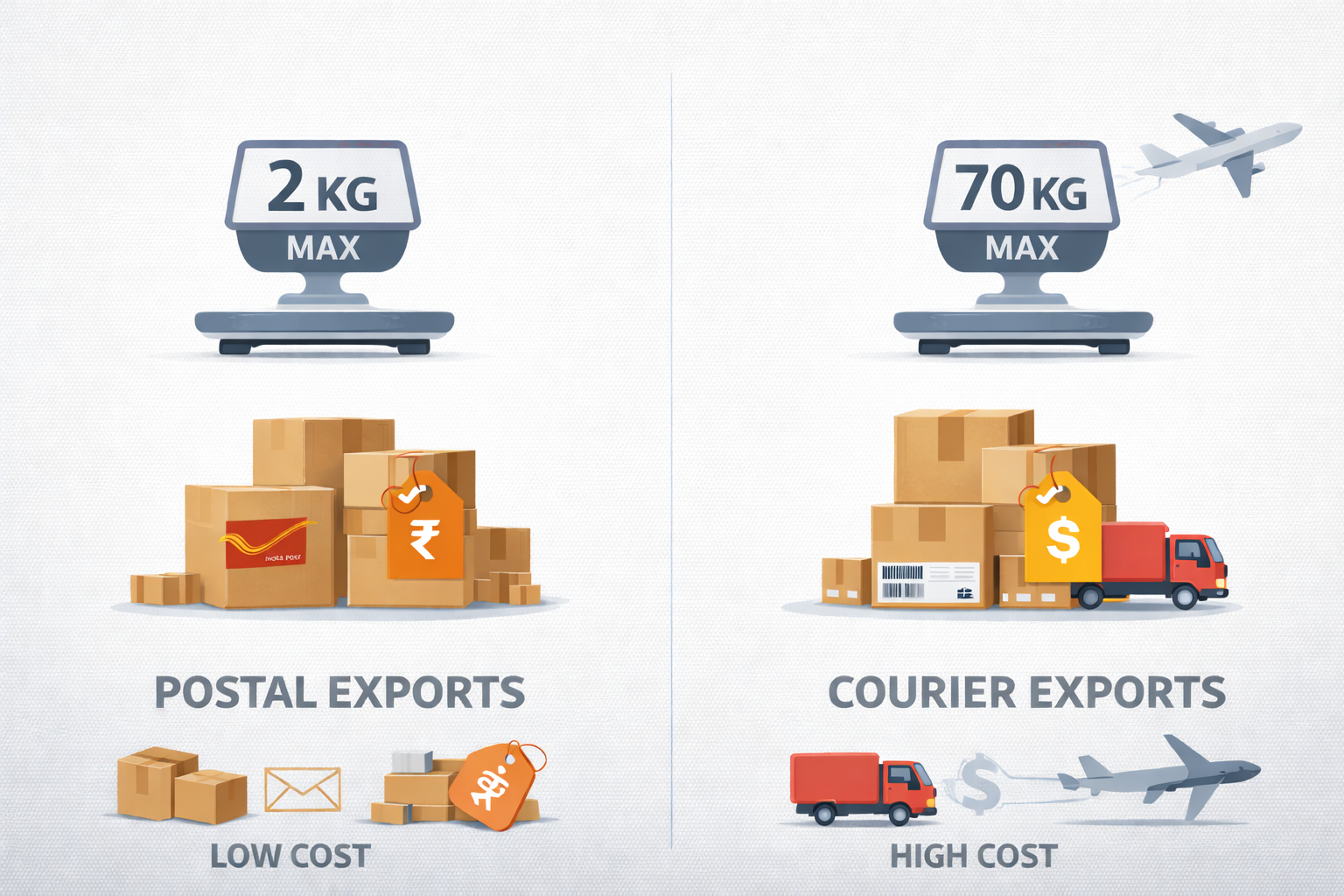
Understanding Postal And Courier Export Weight Limits and Costs
For MSMEs and small exporters entering e-commerce exports, logistics decisions play a major role in determining profitability and customer satisfaction. Among the most important factors in this decision are shipment weight limits and shipping costs. Choosing the wrong export route can significantly increase expenses or limit the type of products that can be exported.
This blog explains how postal and courier export routes differ in terms of weight limits and costs, helping exporters choose the most suitable option for their business—often with guidance from professional eCommerce management services that evaluate logistics, pricing, and compliance together.
Why Weight Limits and Costs Matter in E-Commerce Exports
E-commerce exports typically involve small parcels shipped directly to international buyers. These shipments are priced primarily based on:
- Weight of the parcel
- Dimensions and packaging
- Mode of transport
- Destination country
Understanding these parameters helps exporters:
- Price products correctly for global markets
- Avoid shipment rejections or delays
- Choose the most cost-effective export route
- Improve overall profit margins
Exporters working with experienced eCommerce management services can better align shipping costs with product pricing strategies.
Postal Export Services: Weight Limits and Cost Structure
Postal exports are commonly used by MSMEs for small and lightweight shipments. The postal network offers multiple service options, each with specific weight limits and cost considerations.
Common Postal Export Service Categories
1. International Speed Post (EMS)
- Maximum weight limit: up to 35 kg (subject to destination country restrictions)
- Suitable for relatively heavier parcels
- Offers tracking and faster delivery compared to other postal services
- Higher cost than basic postal options but economical for certain weights
2. International Air Parcel
- Maximum weight limit: up to 20 kg (destination-based)
- Suitable for medium-weight shipments
- Reasonable delivery timelines
- Cost-effective compared to courier services for similar weights
3. International Registered Small Packet
- Weight limit: up to 2 kg
- Designed for lightweight products
- Lower shipping cost
- Limited tracking in some countries
4. International Tracked Packet Service
- Weight limit: up to 2 kg
- Better tracking than basic small packet services
- Slightly higher cost than untracked options
Postal export costs generally increase with weight and service speed. For MSMEs shipping lightweight, low-value products, postal routes offer significant cost advantages—especially when integrated into a structured logistics plan through eCommerce management services.
Cost Advantages of Postal Exports
Postal exports are often preferred by small exporters due to their affordability.
Key Cost Benefits
- Lower base shipping rates
- Economical for low-weight and low-value items
- Possible discounts for frequent shippers
- Suitable for direct-to-consumer exports
These features make postal exports ideal for handicrafts, accessories, small textiles, and gifting items—categories often managed efficiently through end-to-end eCommerce management services.
Courier Export Services: Weight Limits and Cost Structure
Courier services offer a more premium logistics solution with higher reliability and speed. They are commonly used by exporters shipping commercial or time-sensitive goods.
Courier Export Weight Limits
- Support higher shipment values
- Weight limits vary by courier and aircraft capacity
- Suitable for both lightweight and heavier parcels
- Greater flexibility in parcel size and dimensions
Cost Characteristics of Courier Exports
Courier export costs are generally higher than postal services due to enhanced service levels.
Cost Components in Courier Exports
- Base shipping charge based on weight
- Fuel surcharges
- Remote area delivery charges
- Additional fees for pickup, handling, or insurance
While courier services cost more, they offer faster transit times and superior tracking—often recommended by eCommerce management services for premium or high-value orders.
Comparing Postal vs Courier Weight Limits
| Aspect | Postal Services | Courier Services |
| Minimum Weight | Very low (light parcels) | Suitable for all weights |
| Maximum Weight | Up to 35 kg (service-based) | Flexible, service-based |
| Best For | Lightweight products | Commercial shipments |
| Parcel Size Flexibility | Limited | More flexible |
Postal services are ideal for small parcels, while courier services handle a wider range of shipment sizes more efficiently.
Choosing the Right Route Based on Cost and Weight
The ideal export route depends on balancing cost with delivery expectations.
Choose Postal Services If:
- Product weight is low
- Shipment value is modest
- Cost control is a priority
- Delivery timelines are flexible
Choose Courier Services If:
- Shipment is time-sensitive
- Product value is high
- Buyers expect real-time tracking
- Export frequency is high
Many exporters use a hybrid approach—postal services for cost-sensitive orders and courier services for urgent shipments—planned effectively through professional eCommerce management services.
Impact of Weight-Based Costs on Pricing Strategy
Shipping costs directly influence product pricing in international markets.
Why This Matters
- Higher shipping costs reduce price competitiveness
- Incorrect weight estimation impacts margins
- Packaging choices affect final chargeable weight
Exporters must factor logistics costs into pricing strategies to remain competitive—an area where eCommerce management services add significant value.
Importance of Proper Packaging for Weight Optimization
Efficient packaging helps control shipping costs.
Packaging Tips
- Avoid excessive packaging materials
- Use lightweight yet durable packing
- Secure products without unnecessary bulk
Optimized packaging reduces chargeable weight and lowers export costs.
Understanding Destination Country Restrictions
Weight limits may vary based on destination country regulations.
Key Considerations
- Maximum permissible weight differs by country
- Some services may not be available in certain regions
- Exporters must verify destination-specific rules
Failure to check these restrictions can result in shipment rejection or delays—risks that can be minimized with expert eCommerce management support.
Conclusion
Understanding postal and courier export weight limits and costs is essential for MSMEs engaged in e-commerce exports. Postal services offer cost-effective solutions for lightweight and low-value shipments, while courier services provide speed, reliability, and flexibility for commercial exports.
By carefully evaluating product weight, shipment value, customer expectations, and delivery timelines—and aligning logistics decisions with professional eCommerce management services—exporters can control costs, improve buyer satisfaction, and support long-term export growth.
![[object Object]](/_next/image?url=https%3A%2F%2Fcms.msmestory.com%2Fwp-content%2Fuploads%2F2026%2F04%2Fog-6.webp&w=3840&q=75)
![[object Object]](/_next/image?url=https%3A%2F%2Fcms.msmestory.com%2Fwp-content%2Fuploads%2F2026%2F02%2Fog-13.jpg&w=3840&q=75)
![[object Object]](/_next/image?url=https%3A%2F%2Fcms.msmestory.com%2Fwp-content%2Fuploads%2F2026%2F01%2FMSME-export-roadmap.png&w=3840&q=75)
![[object Object]](/_next/image?url=https%3A%2F%2Fcms.msmestory.com%2Fwp-content%2Fuploads%2F2026%2F01%2Fsocial-media-for-export-orders-for-MSMEs.png&w=3840&q=75)
![[object Object]](/_next/image?url=https%3A%2F%2Fcms.msmestory.com%2Fwp-content%2Fuploads%2F2026%2F01%2Fcost-breakdown-of-selling-on-e-commerce-platforms.png&w=3840&q=75)
![[object Object]](/_next/image?url=https%3A%2F%2Fcms.msmestory.com%2Fwp-content%2Fuploads%2F2026%2F01%2Fsocial-commerce-exports-for-global-sales.png&w=3840&q=75)
![[object Object]](/_next/image?url=https%3A%2F%2Fcms.msmestory.com%2Fwp-content%2Fuploads%2F2026%2F01%2FHow-MSMEs-Can-Export-Using-Global-Marketplaces-1.png&w=3840&q=75)
![[object Object]](/_next/image?url=https%3A%2F%2Fcms.msmestory.com%2Fwp-content%2Fuploads%2F2026%2F01%2Fwrite-off-rules-for-unrealised-export-proceeds.png&w=3840&q=75)
![[object Object]](/_next/image?url=https%3A%2F%2Fcms.msmestory.com%2Fwp-content%2Fuploads%2F2026%2F01%2FHandling-Returns-And-Rejections-in-Global-E-Commerce.png&w=3840&q=75)
![[object Object]](/_next/image?url=https%3A%2F%2Fcms.msmestory.com%2Fwp-content%2Fuploads%2F2026%2F01%2FIGST-refund-process-for-e-commerce-exports.png&w=3840&q=75)
![[object Object]](/_next/image?url=https%3A%2F%2Fcms.msmestory.com%2Fwp-content%2Fuploads%2F2026%2F01%2FRBI-guidelines-for-export-payments.png&w=3840&q=75)
![[object Object]](/_next/image?url=https%3A%2F%2Fcms.msmestory.com%2Fwp-content%2Fuploads%2F2026%2F01%2Fhow-MSMEs-receive-payments-from-international-e-commerce-sales.png&w=3840&q=75)
![[object Object]](/_next/image?url=https%3A%2F%2Fcms.msmestory.com%2Fwp-content%2Fuploads%2F2026%2F01%2Fhow-to-reduce-logistics-cost-in-cross-border-e-commerce-1.png&w=3840&q=75)
![[object Object]](/_next/image?url=https%3A%2F%2Fcms.msmestory.com%2Fwp-content%2Fuploads%2F2026%2F01%2FDak-Niryat-Kendra.png&w=3840&q=75)
![[object Object]](/_next/image?url=https%3A%2F%2Fcms.msmestory.com%2Fwp-content%2Fuploads%2F2026%2F01%2FIndia-Post-vs-courier-services-for-e-commerce-exports.png&w=3840&q=75)
![[object Object]](/_next/image?url=https%3A%2F%2Fcms.msmestory.com%2Fwp-content%2Fuploads%2F2026%2F01%2FPackaging-Guidelines-for-E-Commerce-Exports-from-India.png&w=3840&q=75)
![[object Object]](/_next/image?url=https%3A%2F%2Fcms.msmestory.com%2Fwp-content%2Fuploads%2F2026%2F01%2FSEO-Friendly-Product-Descriptions-for-International-E-Commerce.png&w=3840&q=75)
![[object Object]](/_next/image?url=https%3A%2F%2Fcms.msmestory.com%2Fwp-content%2Fuploads%2F2026%2F01%2FProduct-Images-and-Descriptions-for-E-Commerce-Exports.png&w=3840&q=75)
![[object Object]](/_next/image?url=https%3A%2F%2Fcms.msmestory.com%2Fwp-content%2Fuploads%2F2026%2F01%2FHigh-converting-product-catalogue-for-global-buyers.png&w=3840&q=75)