



From Blindness to Boardroom: The Inspiring Journey of Nagababu Jannu
Nagababu Jannu’s story is one of resilience and determination, transcending the limitations imposed by blindness and societal expectations. From his beginnings in a small town in Andhra Pradesh to becoming a Vice President at a global technology firm, his journey highlights the transformative power of education, technology, and unwavering advocacy for equal rights.
A Mother’s Promise Begins a Remarkable Journey
Forty years ago, at a small hospital in Andhra Pradesh, a doctor informed a young couple that their newborn son was blind. Amidst doubts and whispered concerns, the family faced societal stigma that predicted a bleak future for the boy. Many perceived his blindness as a curse, anticipating a life of dependence or begging.
In that hospital room, his mother made a resolute promise: “My son will not beg. He will not live in shame. Even if I must stand against the world, I will make him walk with dignity.” This vow became the foundation of Nagababu’s life journey.
Childhood Marked by Hardship and Determination
Nagababu was born blind in Vuyyuru, Andhra Pradesh, into a family grappling with poverty and instability. His father, a cycle mechanic, struggled with alcoholism, while his mother worked late into the night stitching cloth bags to sustain the household.
Despite widespread beliefs that blindness limited potential, Nagababu’s mother refused to accept such constraints. After relocating to Hyderabad, he enrolled in government schools for blind children, including the Devnar School for the Blind. These institutions introduced him to education and technology’s empowering possibilities, guided by teachers who encouraged focusing on opportunities rather than limitations.
At Devnar, Nagababu forged a lasting friendship with Lingam Pavan Kumar, a fellow student from his village. Their bond grew stronger as they supported each other through various challenges and successes.
In 2001, during his ninth-grade year, Nagababu used a computer for the first time—a significant milestone at a time when technology was still emerging even among sighted students. This experience illuminated the potential of technology as a tool for independence for blind individuals.
Facing Rejection in Engineering Admissions
Determined to pursue engineering, Nagababu applied for a polytechnic diploma after completing Class 10. When he and his mother attempted to purchase the application form, they were informed that candidates with over 40 percent disability were ineligible. Despite this explicit rejection, Nagababu proceeded to apply.
With assistance from a scribe, he took the exam and passed, though his rank was modest. However, during counseling, officials denied him admission once again, with suggestions that he pursue less technical employment instead. Unwavering, Nagababu asserted his right to education and equal treatment.
A Parallel Fight for Rights
Like Nagababu, Pavan Kumar encountered similar obstacles when seeking polytechnic engineering admission. After being denied despite qualifying, he brought his case to the High Court and succeeded. A medical committee assessed his capabilities before granting him college entry.
Changing the Rules Through Legal Action
Nagababu approached the Commissioner of Technical Education, citing the Persons with Disabilities (Equal Opportunities, Protection of Rights and Full Participation) Act of 1995. He articulated his desire not for employment but for the chance to learn and pursue education. Within a five-minute meeting, the Commissioner approved his admission, marking a pivotal victory, though challenges remained.
Overcoming Academic Challenges in Engineering
Engineering studies presented unique difficulties, particularly with technical drawing. A teacher supported Nagababu by using a tactile mesh board, enabling him to grasp complex concepts through touch.
Despite his efforts, educational authorities imposed additional hurdles, refusing to evaluate some exams without extra requirements and forcing him to retake practicals. Nagababu challenged these obstacles in the High Court. Eventually, a university assessed his competencies through a detailed examination lasting several hours, during which he demonstrated his skills in programming, assembly, and navigation.
In October 2005, a government order allowed blind students, including Nagababu, to pursue engineering studies. As the first blind individual in India to complete both a Polytechnic diploma and a Bachelor of Technology in Computer Science, he set a precedent for inclusive education.
“Vision and eyesight are not the same thing. Vision means moving forward even when things are hard. It means choosing to build, learn, and contribute, no matter what life throws at you.” – Nagababu Jannu
Support Along the Way
Legal battles incurred significant financial and emotional strain. Support came from a compassionate schoolteacher who provided financial aid during litigation and from S R Gudlavalleru Engineering College, which sponsored Nagababu’s education and offered evening classes to compensate for time lost due to legal proceedings.
Family support was critical: his mother accompanied him to school daily; his grandmother encouraged his ambitions despite skepticism from others; and his father, despite personal struggles, purchased a computer and initially paid fees prior to fee waivers.
Career Progress and Leadership
In 2007, Nagababu secured a campus placement at Wipro Technologies. Although the company initially hesitated and required additional interviews, he started working in 2009 after recession-related delays. Demonstrating strong performance, he rapidly advanced to Project Engineer.
Over seventeen years and multiple companies, Nagababu rose to the position of Vice President and Lead Software Engineer at a global financial firm. His work relies on technologies like JAWS and NVDA screen-reading software to read and write code effectively.
Continued Barriers and Advocacy
Challenges persist beyond education and employment. In 2010 and 2013, Nagababu faced lengthy delays and refusals when opening bank accounts, requiring intervention from high-level officials. Even in 2026, he encountered outright refusals based on his blindness, reflecting persistent lack of awareness.
Further, many digital platforms remain inaccessible to screen readers, with interface elements lacking proper labels despite existing accessibility guidelines.
Vision Beyond Sight
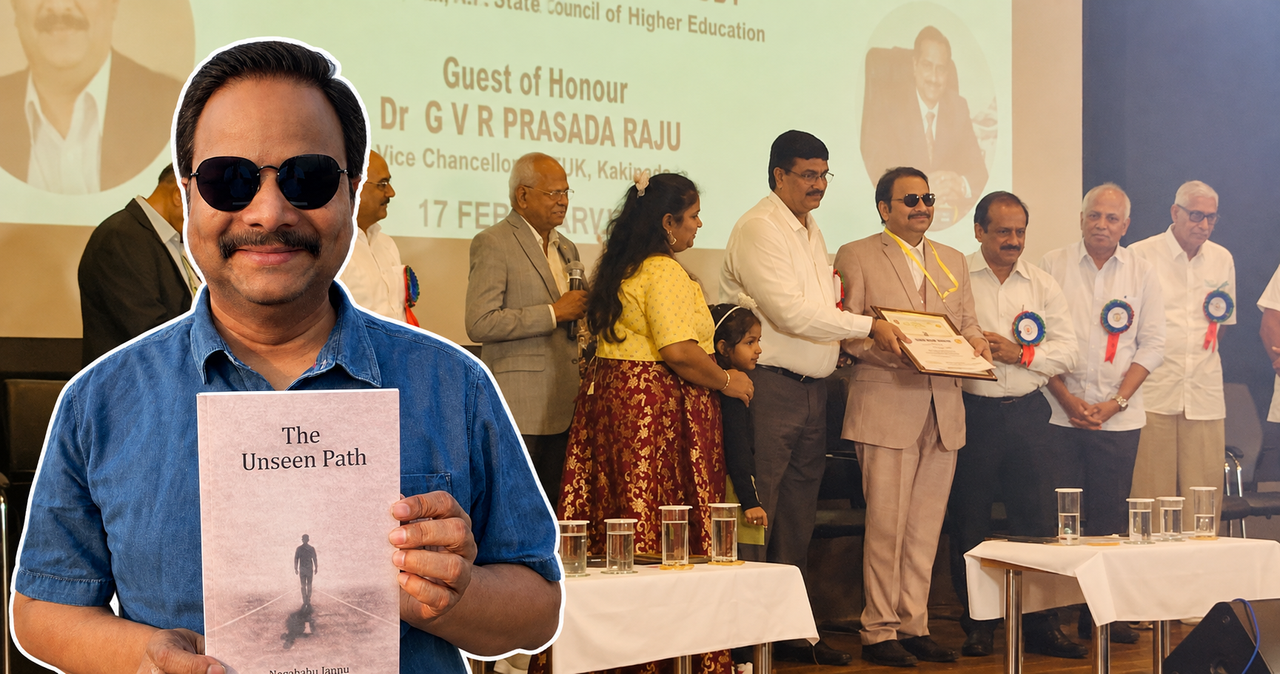
In 2023, after major spinal surgery and living with chronic nerve pain, Nagababu received a thyroid cancer diagnosis while working on his memoir, The Unseen Path. He continued writing from the oncology ward.
Seeking to share his story broadly, Nagababu released The Unseen Path as a free audiobook podcast on YouTube.
Friendship and Shared Struggles
His longtime friend Pavan Kumar, now a manager at the State Bank of India, witnessed Nagababu’s journey firsthand. He also faced delays entering employment after qualifying in 2009.
Their friendship, forged through education, work, and hardships, offered mutual support. Pavan reflects on the significance of maintaining confidence and perseverance in the face of obstacles.
- “We will always face problems,” Pavan says, “but we must never lose courage.”
- “If we believe problems can be solved, the universe will help.”
- “Always hold your belief and keep moving forward. Chase your dreams. Success comes through hard work, not luck.”