









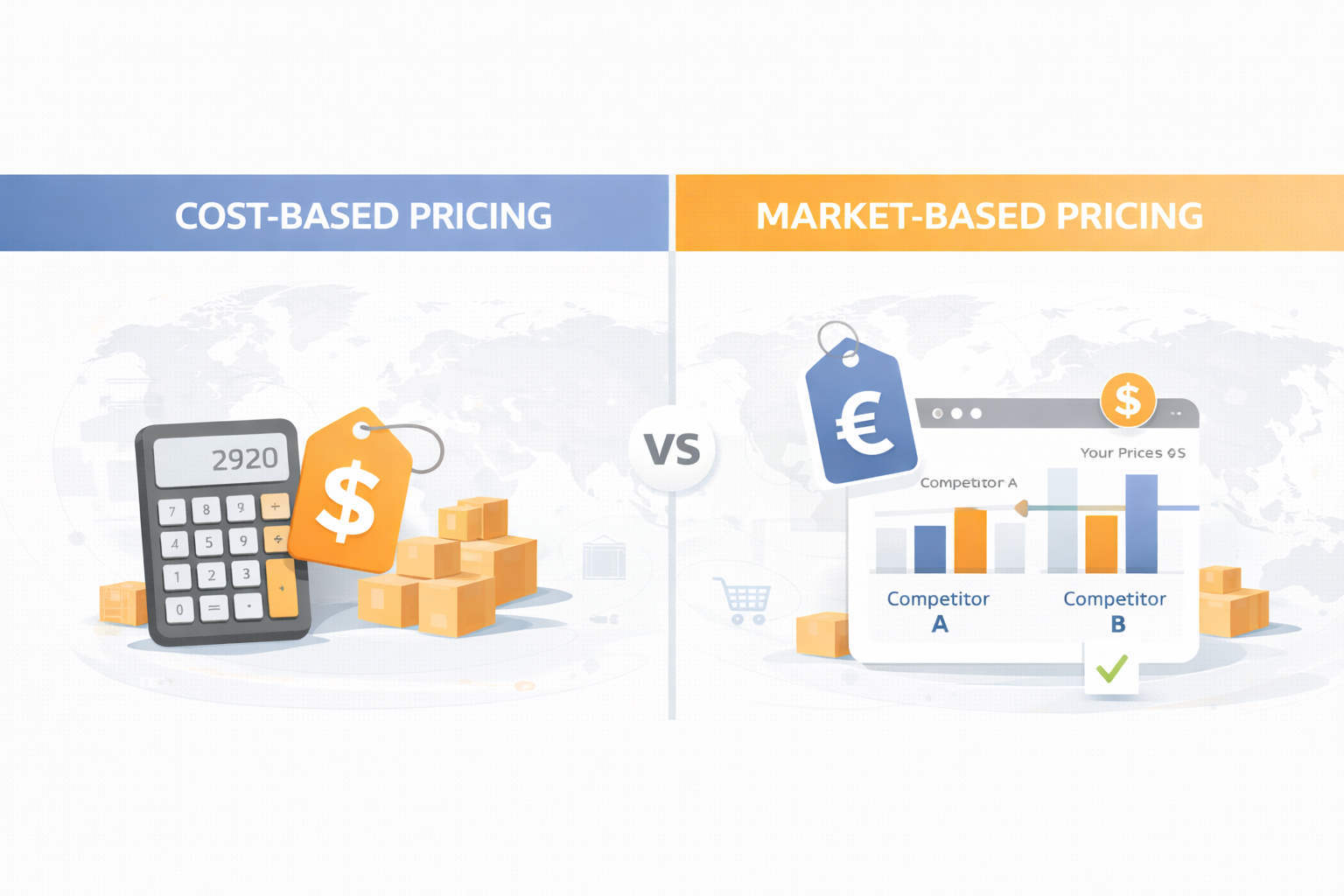
Cost-Based vs Market-Based Pricing for Exporters: A Complete Guide
Pricing plays a decisive role in the success of e-commerce exports. For exporters, especially MSMEs, choosing the right pricing strategy can determine whether a product gains traction in international markets or gets lost among competitors. Two of the most commonly used pricing approaches are cost-based pricing and market-based pricing.
This blog explains how these two strategies work and helps exporters decide which one is more suitable for their business, particularly when supported by professional eCommerce management services.
1. Understanding Cost-Based Pricing
Cost-based pricing is a straightforward pricing method where the selling price is calculated by adding a fixed margin to the total cost of the product.
How Cost-Based Pricing Works
- All costs involved in producing and delivering the product are calculated
- A desired profit margin is added to arrive at the final selling price
Why Exporters Use Cost-Based Pricing
- Easy to calculate and implement
- Ensures all costs are covered
- Ideal for exporters who are new to e-commerce exports
This strategy provides exporters with pricing confidence, especially when they are entering international markets for the first time. Many first-time exporters rely on end-to-end eCommerce management services to accurately calculate export-related costs.
2. Advantages of Cost-Based Pricing for Exporters
Cost-based pricing offers several benefits, particularly for small and medium exporters.
Key Advantages
- Protects profit margins
- Reduces risk of underpricing
- Simple and transparent pricing structure
However, this approach does not always reflect market demand oqr competitor pricing, which is why exporters often refine it using insights from strategic eCommerce export management services.
3. Understanding Market-Based Pricing
Market-based pricing, also known as competitor-oriented pricing, sets prices based on prevailing market rates and competitor pricing.
How Market-Based Pricing Works
- Prices are aligned with what customers are willing to pay
- Competitor prices and overall market trends are closely monitored
- Prices are adjusted to stay competitive
This strategy is widely used in highly competitive international marketplaces where price comparison is common.
4. Advantages of Market-Based Pricing for Exporters
Market-based pricing helps exporters remain relevant and competitive.
Key Advantages
- Matches buyer expectations
- Helps win customers in crowded marketplaces
- Suitable for generic or widely available products
This approach requires continuous monitoring of competitors and market trends, often managed through eCommerce marketplace management services to avoid margin erosion.
5. Key Differences Between Cost-Based and Market-Based Pricing
|
Aspect |
Cost-Based Pricing |
Market-Based Pricing |
| Pricing Basis | Product cost + margin | Market and competitor prices |
| Ease of Use | Simple | Requires analysis |
| Market Responsiveness | Low | High |
| Risk Level | Lower | Moderate |
| Best For | New exporters | Competitive markets |
6. Which Pricing Strategy Is Right for Exporters?
The right pricing strategy depends on multiple factors such as product type, competition, and business maturity.
Choose Cost-Based Pricing If:
- You are a new exporter
- Your product is unique or handcrafted
- You want to ensure stable margins
Choose Market-Based Pricing If:
- You operate in a competitive category
- Similar products are widely available
- Customer price sensitivity is high
Many exporters begin with cost-based pricing and gradually shift to market-based pricing as they gain market insights, often supported by professional eCommerce management services.
7. Using Both Strategies Together
Successful exporters often combine both approaches.
Hybrid Approach
- Use cost-based pricing as a baseline
- Adjust prices based on market conditions
- Remain flexible and responsive to demand
This balanced approach helps exporters stay profitable while remaining competitive in global markets.
Conclusion
There is no single “right” pricing strategy for all exporters. Cost-based pricing offers simplicity and margin protection, while market-based pricing provides competitiveness and market alignment.
Exporters who understand both approaches and apply them strategically—supported by eCommerce management services—are better positioned to succeed in global e-commerce markets.
![[object Object]](/_next/image?url=https%3A%2F%2Fcms.msmestory.com%2Fwp-content%2Fuploads%2F2026%2F04%2Fog-6.webp&w=3840&q=75)
![[object Object]](/_next/image?url=https%3A%2F%2Fcms.msmestory.com%2Fwp-content%2Fuploads%2F2026%2F02%2Fog-13.jpg&w=3840&q=75)
![[object Object]](/_next/image?url=https%3A%2F%2Fcms.msmestory.com%2Fwp-content%2Fuploads%2F2026%2F01%2FMSME-export-roadmap.png&w=3840&q=75)
![[object Object]](/_next/image?url=https%3A%2F%2Fcms.msmestory.com%2Fwp-content%2Fuploads%2F2026%2F01%2Fsocial-media-for-export-orders-for-MSMEs.png&w=3840&q=75)
![[object Object]](/_next/image?url=https%3A%2F%2Fcms.msmestory.com%2Fwp-content%2Fuploads%2F2026%2F01%2Fcost-breakdown-of-selling-on-e-commerce-platforms.png&w=3840&q=75)
![[object Object]](/_next/image?url=https%3A%2F%2Fcms.msmestory.com%2Fwp-content%2Fuploads%2F2026%2F01%2Fsocial-commerce-exports-for-global-sales.png&w=3840&q=75)
![[object Object]](/_next/image?url=https%3A%2F%2Fcms.msmestory.com%2Fwp-content%2Fuploads%2F2026%2F01%2FHow-MSMEs-Can-Export-Using-Global-Marketplaces-1.png&w=3840&q=75)
![[object Object]](/_next/image?url=https%3A%2F%2Fcms.msmestory.com%2Fwp-content%2Fuploads%2F2026%2F01%2Fwrite-off-rules-for-unrealised-export-proceeds.png&w=3840&q=75)
![[object Object]](/_next/image?url=https%3A%2F%2Fcms.msmestory.com%2Fwp-content%2Fuploads%2F2026%2F01%2FHandling-Returns-And-Rejections-in-Global-E-Commerce.png&w=3840&q=75)
![[object Object]](/_next/image?url=https%3A%2F%2Fcms.msmestory.com%2Fwp-content%2Fuploads%2F2026%2F01%2FIGST-refund-process-for-e-commerce-exports.png&w=3840&q=75)
![[object Object]](/_next/image?url=https%3A%2F%2Fcms.msmestory.com%2Fwp-content%2Fuploads%2F2026%2F01%2FRBI-guidelines-for-export-payments.png&w=3840&q=75)
![[object Object]](/_next/image?url=https%3A%2F%2Fcms.msmestory.com%2Fwp-content%2Fuploads%2F2026%2F01%2Fhow-MSMEs-receive-payments-from-international-e-commerce-sales.png&w=3840&q=75)
![[object Object]](/_next/image?url=https%3A%2F%2Fcms.msmestory.com%2Fwp-content%2Fuploads%2F2026%2F01%2Fhow-to-reduce-logistics-cost-in-cross-border-e-commerce-1.png&w=3840&q=75)
![[object Object]](/_next/image?url=https%3A%2F%2Fcms.msmestory.com%2Fwp-content%2Fuploads%2F2026%2F01%2FPostal-and-courier-export-weight-limits-and-costs.png&w=3840&q=75)
![[object Object]](/_next/image?url=https%3A%2F%2Fcms.msmestory.com%2Fwp-content%2Fuploads%2F2026%2F01%2FDak-Niryat-Kendra.png&w=3840&q=75)
![[object Object]](/_next/image?url=https%3A%2F%2Fcms.msmestory.com%2Fwp-content%2Fuploads%2F2026%2F01%2FIndia-Post-vs-courier-services-for-e-commerce-exports.png&w=3840&q=75)
![[object Object]](/_next/image?url=https%3A%2F%2Fcms.msmestory.com%2Fwp-content%2Fuploads%2F2026%2F01%2FPackaging-Guidelines-for-E-Commerce-Exports-from-India.png&w=3840&q=75)
![[object Object]](/_next/image?url=https%3A%2F%2Fcms.msmestory.com%2Fwp-content%2Fuploads%2F2026%2F01%2FSEO-Friendly-Product-Descriptions-for-International-E-Commerce.png&w=3840&q=75)
![[object Object]](/_next/image?url=https%3A%2F%2Fcms.msmestory.com%2Fwp-content%2Fuploads%2F2026%2F01%2FProduct-Images-and-Descriptions-for-E-Commerce-Exports.png&w=3840&q=75)
![[object Object]](/_next/image?url=https%3A%2F%2Fcms.msmestory.com%2Fwp-content%2Fuploads%2F2026%2F01%2FHigh-converting-product-catalogue-for-global-buyers.png&w=3840&q=75)