




Traditional Export vs E-Commerce Export: Which Is Better for MSMEs?
Introduction
India is aiming to achieve an ambitious USD 1 Trillion merchandise export target by 2030, requiring sustained annual growth of over 12%. To meet this goal, export growth must move beyond conventional channels and embrace new, technology-driven pathways. One of the most significant among these is cross-border e-commerce exports, which are rapidly transforming global trade—especially for Micro, Small, and Medium Enterprises (MSMEs).
As highlighted in the DGFT E-Commerce Exports Handbook, global cross-border e-commerce is projected to grow from USD 800 billion by 2025 to nearly USD 2 trillion by 2030. This rapid expansion positions e-commerce as a strong alternative to traditional export models for Indian MSMEs looking to access international markets efficiently.
This leads to an important question for small businesses:
Traditional Export vs E-Commerce Export – which is better for MSMEs?
What Is Traditional Export?
Traditional exports typically follow a conventional supply chain involving multiple stakeholders and manual processes. This traditional export model usually includes:
-
Multiple intermediaries such as agents, distributors, and importers
-
Separate service providers for marketing, logistics, payments, and regulatory compliance
-
Higher infrastructure and operational costs
-
Longer turnaround times and complex coordination
While this model works well for large exporters handling bulk shipments or long-term B2B contracts, it often creates significant entry barriers for MSMEs, including high upfront investment, limited flexibility, and restricted global visibility.
What Is E-Commerce Export?
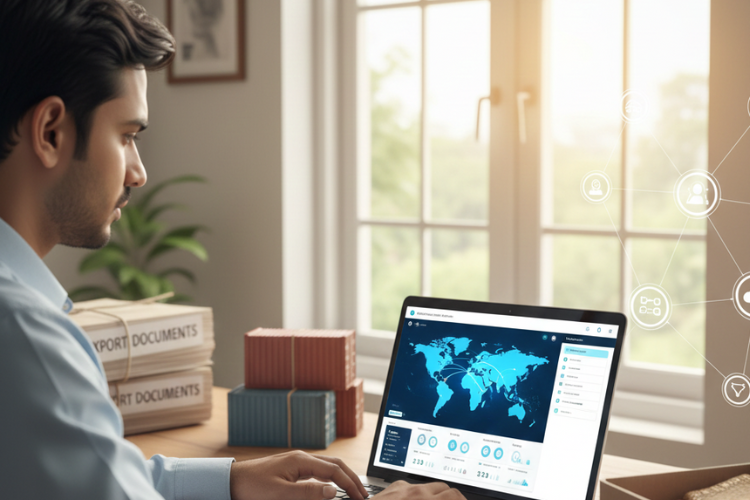
In contrast, e-commerce exports for MSMEs allow businesses to sell directly to international customers through online marketplaces and digital platforms. According to the DGFT handbook, e-commerce platforms operate as integrated ecosystems, offering multiple services under one framework:
-
Product cataloguing and listing support
-
Market research and digital marketing tools
-
Integrated payment solutions
-
Pick-up, logistics, and last-mile delivery
-
Export payment reconciliation
This integrated approach drastically reduces the time, cost, and operational complexity involved in exporting, while also simplifying cross-border e-commerce compliance for MSMEs and first-time exporters.
Traditional Export vs E-Commerce Export: Key Comparison
| Aspect | Traditional Export | E-Commerce Export |
|---|---|---|
| Market Access | Limited, distributor-driven | Global, direct access |
| Infrastructure Cost | High | Low |
| Customer Reach | Mainly B2B | Direct-to-Consumer (B2C) |
| Marketing | Manual and expensive | Digital and platform-supported |
| Logistics | Fragmented | Integrated logistics |
| Time to Market | Slow | Faster |
| Profit Margins | Lower due to intermediaries | Higher through D2C sales |
Many MSMEs also choose to work with eCommerce management services to streamline product listings, logistics coordination, order management, and cross-border compliance, enabling them to scale faster without operational strain.
Advantages of E-Commerce Exports for MSMEs
As outlined in Figure 2 of the DGFT handbook, e-commerce exports offer several strategic advantages for MSMEs:
1. Access to a Larger International Market
MSMEs can reach customers across multiple countries without establishing physical offices or overseas distribution networks.
2. Lower Infrastructure Costs
Unlike traditional exports, e-commerce does not require foreign warehouses, agents, or extensive on-ground presence during the initial stages.
3. Better Profit Margins
By selling directly to consumers, MSMEs eliminate middlemen and retain a larger share of the final selling price.
4. Enhanced Brand Visibility and Global Standards
Selling online improves international brand visibility and exposes MSMEs to global quality benchmarks, trends, and customer expectations.
5. Reduced Dependence on Seasonal Demand
E-commerce enables exporters to diversify across geographies, helping them manage demand fluctuations and reduce reliance on domestic seasonality.
Role of Government and DGFT Support
The Foreign Trade Policy (FTP) 2023 places strong emphasis on enabling cross-border e-commerce for MSMEs, artisans, and craftsmen. Under the DGFT e-commerce export guidelines, coordinated efforts are underway with:
-
Customs Authorities
-
Department of Posts through Dak Niryat Kendras
-
Industry partners and knowledge institutions
These initiatives aim to simplify B2C exports through postal and courier routes, improve awareness, and reduce compliance-related challenges, making global trade more inclusive for small businesses.
So, Which Is Better for MSMEs?
✅ E-Commerce Export is clearly the better option for MSMEs because it:
-
Lowers entry barriers to global trade
-
Reduces costs and operational complexity
-
Enables faster international market access
-
Supports small-volume, high-value shipments
While traditional exports may still be suitable for bulk or large-scale B2B transactions, e-commerce exports offer a faster, safer, and more scalable pathway for MSMEs and first-time exporters.
Conclusion
The comparison between Traditional Export vs E-Commerce Export clearly highlights why digital export models are better aligned with the needs of modern MSMEs. Traditional exports remain relevant for certain use cases, but they often involve higher costs, multiple intermediaries, and rigid processes.
E-commerce exports, on the other hand, empower MSMEs with direct global access, integrated services, improved margins, and operational flexibility. Backed by government initiatives and evolving digital infrastructure, cross-border e-commerce is no longer optional—it is the future of MSME exports. Ensuring proper MSME export compliance and planning can further accelerate sustainable global growth.
MSME export planning, registration & compliance support.
![[object Object]](/_next/image?url=https%3A%2F%2Fcms.msmestory.com%2Fwp-content%2Fuploads%2F2026%2F04%2Fog-6.webp&w=3840&q=75)
![[object Object]](/_next/image?url=https%3A%2F%2Fcms.msmestory.com%2Fwp-content%2Fuploads%2F2026%2F02%2Fog-13.jpg&w=3840&q=75)
![[object Object]](/_next/image?url=https%3A%2F%2Fcms.msmestory.com%2Fwp-content%2Fuploads%2F2026%2F01%2FMSME-export-roadmap.png&w=3840&q=75)
![[object Object]](/_next/image?url=https%3A%2F%2Fcms.msmestory.com%2Fwp-content%2Fuploads%2F2026%2F01%2Fsocial-media-for-export-orders-for-MSMEs.png&w=3840&q=75)
![[object Object]](/_next/image?url=https%3A%2F%2Fcms.msmestory.com%2Fwp-content%2Fuploads%2F2026%2F01%2Fcost-breakdown-of-selling-on-e-commerce-platforms.png&w=3840&q=75)