







How Small Businesses Can Export Globally Without Big Infrastructure
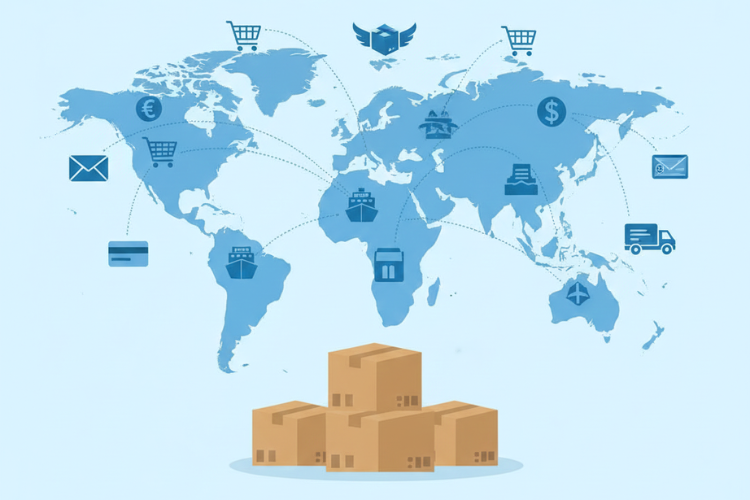
Global trade is no longer limited to large corporations with massive warehouses, overseas offices, and complex supply chains. Today, small businesses and MSMEs can export globally without building heavy infrastructure, thanks to cross-border e-commerce.
Governments, digital platforms, logistics providers, and payment gateways are collectively lowering entry barriers to international trade, making it easier for MSMEs to take Indian products to global markets. E-commerce is emerging as a key growth driver for India’s export ecosystem.
This blog explains how small businesses can tap global markets efficiently, cost-effectively, and digitally—without investing in traditional export infrastructure.
The Global Opportunity for Small Exporters
India has set an ambitious target of USD 1 trillion in merchandise exports by 2030, with a projected annual growth rate of over 12%. Achieving this goal requires participation from new and emerging exporters, especially MSMEs.
Cross-border e-commerce plays a crucial role here. Global e-commerce exports are expected to grow from USD 800 billion by 2025 to nearly USD 2 trillion by 2030, accounting for around 6.6% of total global merchandise trade. This rapid expansion opens up unprecedented opportunities for small sellers to access international customers directly
Traditional Exports vs E-Commerce Exports
One of the biggest challenges for small businesses has always been the high cost and complexity of traditional exports. Conventional exporting often involves:
- Separate market research agencies
- Independent marketing and branding costs
- Third-party logistics coordination
- Manual payment reconciliation
In contrast, e-commerce platforms offer an integrated export ecosystem.
What E-Commerce Simplifies
A comparison between selling through e-commerce and traditional export models highlights key differences in efficiency and cost:
- Market research, marketing, branding, logistics, and payments are bundled into one platform
- Sellers save time and operational costs
- Businesses can focus more on product quality, packaging, and customer experience
This integration eliminates the need for heavy infrastructure such as overseas distributors, warehouses, or agents.
Why E-Commerce is Ideal for Small Businesses
According to Figure 2 (Advantages of Selling through E-Commerce), e-commerce exports provide multiple strategic advantages to MSMEs:
1. Lower Infrastructure Costs
E-commerce requires minimal physical infrastructure compared to traditional exports. Sellers can operate from their existing facilities while platforms handle global reach.
2. Direct-to-Consumer (D2C) Sales
Selling directly to international customers improves profit margins by removing intermediaries.
3. Access to Global Markets
Small businesses gain instant access to a large international customer base, beyond domestic limitations.
4. Stronger Brand Visibility
Global exposure helps businesses understand international quality standards, trends, and customer preferences, strengthening long-term brand value.
5. Reduced Demand Fluctuations
By selling in multiple countries, exporters can offset domestic seasonality and maintain steady demand throughout the year
Global exposure helps businesses understand international quality standards, trends, and customer preferences. With the support of e-commerce marketing services, MSMEs can strengthen brand visibility, improve product rankings, and reach the right international audience.
Government Support Enabling Low-Cost Exports
The Foreign Trade Policy (FTP) 2023 emphasizes enabling cross-border e-commerce for artisans, weavers, craftsmen, and MSMEs. DGFT is actively working with:
- Customs authorities
- Department of Posts
- Industry and logistics partners
A key initiative is the expansion of Dak Niryat Kendras (DNKs), which support B2C exports through the postal route. Globally, nearly two-thirds of international parcels under 2 kg are shipped via postal services, making this a cost-effective option for small exporters
This ecosystem allows even micro-entrepreneurs to start exporting without investing in private couriers or overseas logistics networks.
How Small Businesses Can Start Exporting Without Big Infrastructure
Here’s a simplified roadmap to help MSMEs start exporting efficiently:
- Choose the Right E-Commerce Platform
Select global or regional marketplaces that offer integrated logistics and payments. - Focus on Product Strength
Emphasize quality, packaging, and compliance with international standards. - Leverage Integrated Services
Use platform-provided tools for cataloguing, marketing, shipping, and payments. Partnering with expert e-commerce marketing services helps MSMEs maximize reach, optimize campaigns, and scale exports faster. - Start Small, Scale Fast
Begin with lightweight shipments and scale based on demand and feedback. - Use Postal and Government-Backed Channels
Reduce costs by leveraging DNKs and postal export services.
Conclusion: Global Exports Are Now MSME-Friendly
E-commerce has fundamentally transformed the export landscape. What once required large capital, infrastructure, and international networks can now be achieved with a digital storefront, a quality product, and the right platform.
For small businesses and MSMEs, exporting globally is no longer a distant dream—it is a scalable, affordable, and government-supported opportunity. With integrated services, reduced costs, and growing global demand, e-commerce exports are the fastest way for small businesses to go global without big infrastructure.
Need expert guidance to start or scale your exports?
We support MSMEs with export planning, registration, documentation, compliance, logistics coordination, and payment advisory—so you can focus on growing your global business with confidence.
![[object Object]](/_next/image?url=https%3A%2F%2Fcms.msmestory.com%2Fwp-content%2Fuploads%2F2026%2F04%2Fog-6.webp&w=3840&q=75)
![[object Object]](/_next/image?url=https%3A%2F%2Fcms.msmestory.com%2Fwp-content%2Fuploads%2F2026%2F02%2Fog-13.jpg&w=3840&q=75)
![[object Object]](/_next/image?url=https%3A%2F%2Fcms.msmestory.com%2Fwp-content%2Fuploads%2F2026%2F01%2FMSME-export-roadmap.png&w=3840&q=75)
![[object Object]](/_next/image?url=https%3A%2F%2Fcms.msmestory.com%2Fwp-content%2Fuploads%2F2026%2F01%2Fsocial-media-for-export-orders-for-MSMEs.png&w=3840&q=75)
![[object Object]](/_next/image?url=https%3A%2F%2Fcms.msmestory.com%2Fwp-content%2Fuploads%2F2026%2F01%2Fcost-breakdown-of-selling-on-e-commerce-platforms.png&w=3840&q=75)