







Air Travel Costs Rise Sharply as User Development Fees Increase Nearly 300% Nationwide in Last Decade
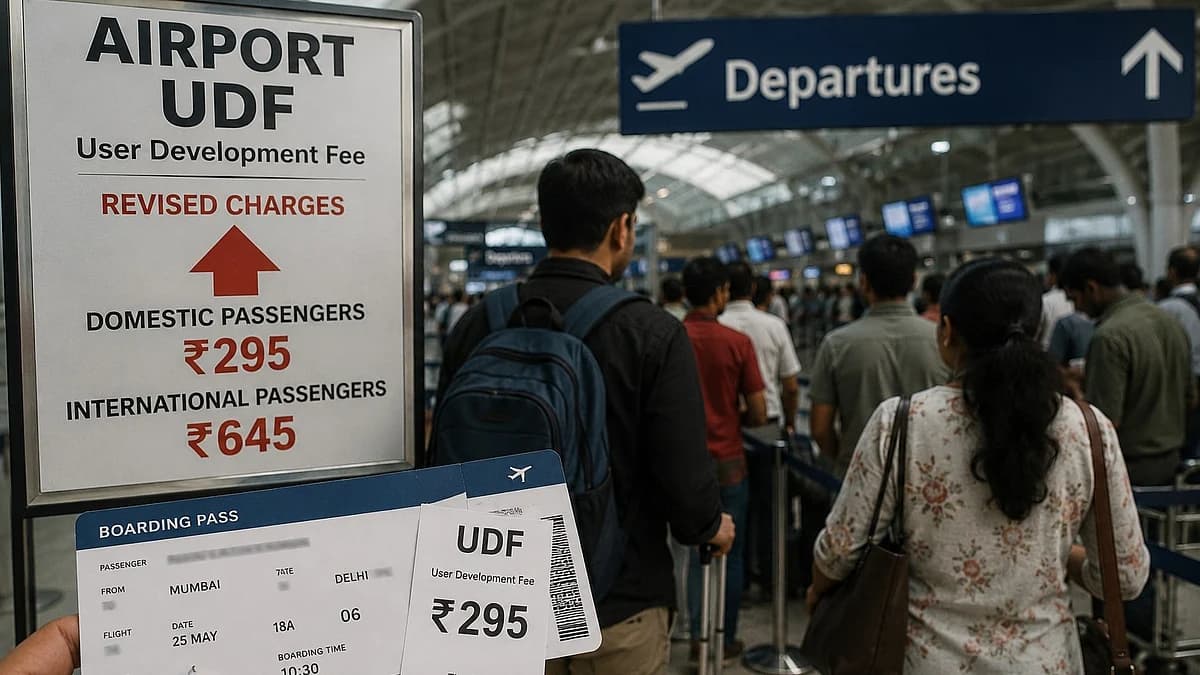
Mumbai: The cost of flying from major airports in India has significantly increased over the past four years due to substantial hikes in User Development Fees (UDF) imposed on departing passengers at key airports across the nation. Among these, Ahmedabad Airport recorded the highest surge in international UDF, escalating by 1,300%.
On average, domestic UDF at ten major Indian airports has risen by 200%, while international UDF has increased by 387% during this period.
Understanding User Development Fees (UDF)
The UDF, set by the Airports Economic Regulatory Authority of India (AERA), is collected directly from passengers by airport concessionaires. These fees support capital expenditures and operational expenses at airports.
Tariff Changes Across Major Indian Airports
Information presented in the Lok Sabha highlights notable changes in tariff structures from March 2022 to March 2026 across ten prominent airports.
- Mumbai Airport: International UDF for departing economy passengers increased by 259%, rising from Rs 171 to Rs 615, and reached Rs 695 for business class travelers.
- Ahmedabad Airport: International UDF surged by 1,300%, from Rs 85 to Rs 1,190. Domestic UDF rose 605%, from Rs 85 to Rs 600.
- Chennai Airport: Domestic UDF increased by 494% from Rs 69 to Rs 410, while international UDF grew 805%, from Rs 69 to Rs 625.
- Delhi’s Indira Gandhi International Airport: International departing fees for economy class passengers rose 400%, from Rs 130 to Rs 650. Domestic departing fees slightly decreased by 0.76%, from Rs 130 to Rs 129.
- Southern Airports: Bengaluru saw domestic UDF rise 198% (Rs 184 to Rs 550) and international UDF increase 78% (Rs 839 to Rs 1,500). Hyderabad’s domestic UDF climbed 166% (Rs 281 to Rs 750) and international UDF surged 281% (Rs 393 to Rs 1,500). Cochin and Goa’s Dabolim Airports also experienced hikes with domestic UDF expanding 285% and 89%, respectively, and international UDF increasing by 78% and 49%, respectively.
- Kolkata Airport: Netaji Subhash Chandra Bose International Airport was the only major hub to record declines in both domestic and international fees, falling by 6%.
Government and Regulatory Perspective
The Ministry of Civil Aviation defended the tariff revisions, stating that AERA applies a consistent regulatory framework to all significant airports, regardless of ownership or management model.
Concerns about potential cost inflation from concessionaire practices such as excessive capital expenditure or operational costs were addressed by noting that all expenses undergo strict technical and financial review. Only prudently and efficiently incurred costs are approved for tariff calculations.
Impact and Future Outlook
Although AERA does not directly regulate non-aeronautical services such as retail, food and beverage, and parking, regulations require that 30% of revenues from these sources subsidize aeronautical charges to mitigate passenger costs.
Despite these controls, the significant fee increases reflect substantial capital investments made for airport infrastructure expansion during recent regulatory periods.
Key Takeaways
- User Development Fees at major Indian airports have increased sharply over the past four years, with international fees rising nearly 387% on average.
- Ahmedabad Airport experienced the most dramatic increase in international UDF, rising 1,300%.
- Most major airports have raised fees significantly, except Kolkata, which saw a decline in passenger fees.
- The Ministry of Civil Aviation maintains that fee hikes follow a regulated and consistent framework overseen by AERA.
- Fee increases correspond to major capital investments aimed at enhancing airport infrastructure nationwide.
![[object Object]](/_next/image?url=https%3A%2F%2Fcms.msmestory.com%2Fwp-content%2Fuploads%2F2026%2F08%2Fog-6.jpg&w=3840&q=75)
![[object Object]](/_next/image?url=https%3A%2F%2Fcms.msmestory.com%2Fwp-content%2Fuploads%2F2026%2F08%2Fog-2.jpg&w=3840&q=75)
![[object Object]](/_next/image?url=https%3A%2F%2Fcms.msmestory.com%2Fwp-content%2Fuploads%2F2026%2F08%2Fog.webp&w=3840&q=75)