


A revolutionary digital platform is transforming the agricultural labour market in Nashik’s grape-growing region, significantly increasing farm workers’ earnings and streamlining labour coordination. By leveraging artificial intelligence and familiar communication channels, this innovation is addressing longstanding inefficiencies and uncertainties in rural employment, fostering a more predictable and fair labour ecosystem.
Early Morning in Nashik’s Vineyards
The sun has just started to rise over a vineyard in Nashik’s grape-growing region, yet the workday has already begun.
Farmer Bapusaheb Salunkhe stands among neatly trimmed vines. He looks at his phone—not to check messages but to organize labour. With a few taps on WhatsApp, a team is already assigned for the day. There are no rushed phone calls, no trips to the labour market at dawn, and no last-minute confusion.
“They come on time now,” he says calmly. “Before, it was hard to find labour, but after using this platform, my problem is solved.”
This change—from uncertainty to reliable scheduling—is the goal of Bharat Intelligence.
The Challenge of Farm Labour
As co-founder Azaan Merchant explains, “Farmers kept talking about labour problems. It was accepted as a fact, but no one tried to fix it.”
India has over 144.3 million agricultural workers, making it one of the largest labour forces worldwide. Despite this size, the system is still based on guesswork.
There is little trustworthy information on who the workers are, where they move, what skills they have, or when they are available. Farmers face constant pressure, especially in horticulture, where timing can make or break a harvest.
Traditionally, farmers find labour by:
- Calling neighbours or nearby villages
- Going to a labour market (labour chowk) early in the morning to hire on the spot
- Using middlemen (mukadams), often involving advances and lots of uncertainty
This causes mistrust. Farmers worry if workers will show up or have the right skills. Workers worry about payment and job security.
Because farm work is time-sensitive, even a delay of one or two days can destroy a crop cycle.
Changing the System with Technology
Bharat Intelligence is shifting from this old system of labour markets and middlemen to a digitally managed rural workforce network.
Interestingly, the problem isn’t the lack of labour but poor coordination.
“People are there,” says co-founder Gaurav Sanghai. “The real problem is knowing who is available, when, and how to connect them efficiently. We decided to solve it as a matchmaking problem.”
Founders with a Vision
Azaan Merchant’s path to rural India was unexpected. He spent nearly 10 years abroad investing in technology companies across the UK and California. He grew a venture capital fund from $50 million to $400 million and worked with firms valued over Rs 10,000 crore.
After returning to India, he joined the board of an NGO in agriculture. This gave him his first exposure to rural India.
He then spent 18 months travelling Maharashtra, living with farmers, and studying horticulture.
“The more I saw, the more I realized there was huge potential to help millions through simple solutions,” he says.
Two years ago, Azaan left a high-paying AI job to become an agripreneur.
His co-founder Gaurav, an engineer with a Master’s in Artificial Intelligence from IIT, brought technical expertise.
They met at a venture incubator designed to help founders find co-founders.
“Amazing technical skills and a nation-first attitude,” says Azaan about Gaurav.
Together, they planned to organize India’s labour system with technology.
Building Bharat’s Labour Operating System
Bharat Intelligence was registered in 2024 and began official operations in 2025. It is an AI-driven platform aiming to organize India’s fragmented farm labour market.
At its core is a ‘Labour OS’—a system that maps and connects both workers and farmers.
Farmers and labourers use familiar tools like WhatsApp and phone calls to communicate—no new app is needed.
Behind the scenes, the system gathers around 100 data points per farmer, such as crop type, land size, planting or pruning dates, and local patterns. This helps predict exactly when labour is needed.
For example, in grape farming, once the pruning date is set, the entire sequence of activities over the next 130 days can be planned.
On the worker side, Bharat Intelligence uses a ‘Digital Village’ model. It maps labour pools across thousands of villages by:
- Using village data and migration trends
- Connecting with local leaders like sarpanches and CSC operators
- Tracking worker skills, availability, and reliability
- Considering social and cultural factors
All this data forms a “Rural Intelligence Knowledge Graph,” a live map of India’s labour system.
“We aim to become the operating system for labour,” says Gaurav. “Understanding who does what, where, and connecting them efficiently.”
How It Helps Farmers and Workers
For farmers, this means they can book labour for a whole season instead of hiring day-by-day.
For example, if a farmer has three acres of grapes, Bharat Intelligence arranges the right number of workers with needed skills at the right times throughout the crop cycle.
Farmers pay about Rs 25,000 per acre, and the platform handles logistics, coordination, and quality control.
For workers, the change is even bigger.
Previously, people like 28-year-old Janardhan Bhoye faced uncertainty. Sometimes they were promised work for five acres but only ended up with two and a half. Payments were delayed.
Now, they have steady work.
“We don’t have to search for work anymore,” Janardhan says. “The company helps us find it.”
Labour teams get guaranteed work for up to 300 days annually. Instead of daily wages that vary, they get paid based on their output. This system lets them earn more if they work efficiently.
Daily wages range between Rs 800 and Rs 1,000. But the main change is consistency.
Workers who used to earn Rs 6,000 to Rs 7,000 monthly now earn around Rs 20,000.
There is also more dignity. They no longer wait at labour markets or accept low wages. Instead, they get fair pay and recognition for their skills.
“It’s much better than before,” Janardhan adds. “It saves time and benefits us overall.”
From Chaos to Predictability
The platform’s success shows in pilot areas like Nashik. So far, it has managed over 5,000 acres of vineyards. It deployed 3,000 workers with 2,000 more joining.
The platform has an 86% repeat farmer rate. In just 10 days, it generated a job pipeline worth over Rs 2 crore—all without spending on marketing.
Farmers’ biggest relief is peace of mind. Azaan says, “They just want labour to come on time. Once that happens regularly, trust grows.”
Farmers start growing more valuable crops. Yields improve because everything happens on schedule. Income can rise by 30–40%.
For workers, the benefits go beyond income. The platform offers skill certification and formal recognition. It creates digital work profiles and improves access to social benefits and insurance.
It also stabilizes migration. With predictable jobs, workers can plan better.
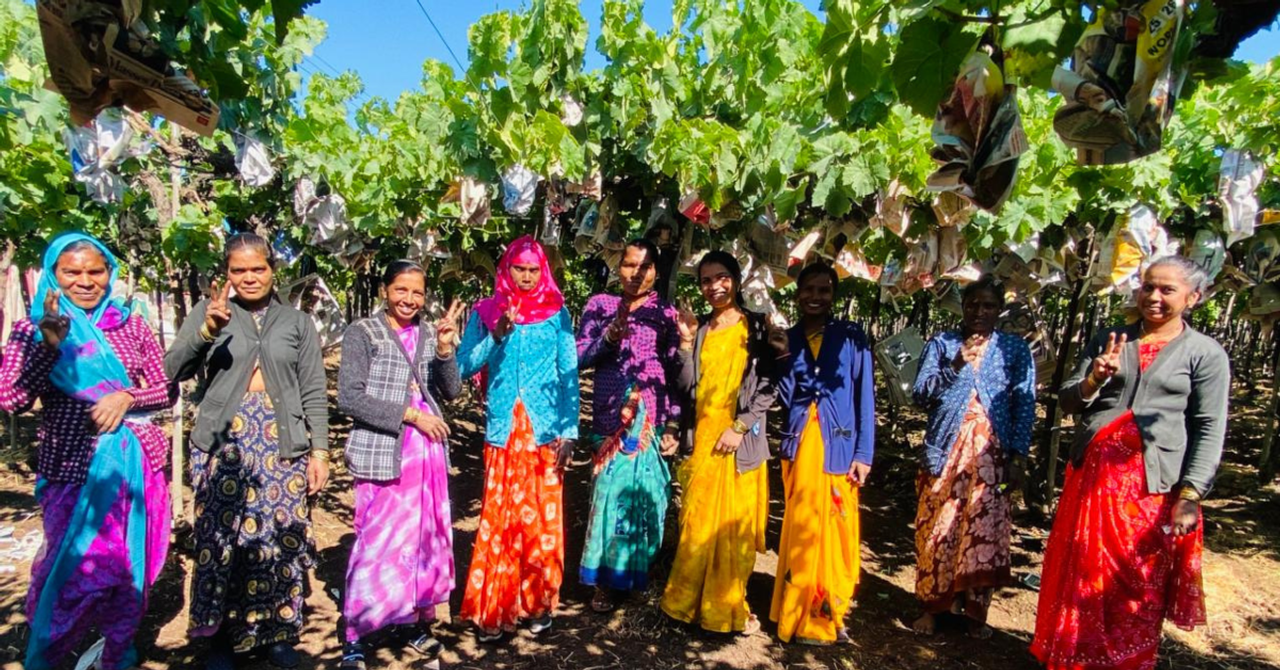
Half of the platform’s workforce are women, many working with their spouses. This often doubles household income.
“In some cases, families go from Rs 50,000 a year to Rs 3–4 lakh,” Azaan notes. “That’s a big change.”
Plans for the Future
The founders know this is a tough challenge. It’s not just about moving packages. It’s about coordinating people.
Making sure thousands of workers arrive on time at farms, with the right skills and attitude, is complex.
But the opportunity is huge. Nashik’s grape sector alone has about 600,000 workers.
Beyond grapes, there are crops like bananas, cotton, sugarcane, and coffee—each with its own labour needs.
Their plan is to build a successful model in one region, then expand to more crops and locations.
Within five years, Bharat Intelligence aims to organize 1 million rural workers. This would create infrastructure for dignified, reliable agricultural jobs at scale.
A System That Works
Back in the vineyard, the workday is in full swing. Teams prune vines confidently, knowing exactly what to do.
There is no doubt about who is responsible or if the work will finish on time.
For farmers like Bapusaheb, this certainty is invaluable. What was once a daily struggle has become smooth and predictable.
“The platform is very convenient on WhatsApp,” he says. “Everything gets done quicker and always on time.”
For workers like Janardhan, the change is not just financial. It means stability, respect, and less dependence on unstable labour markets.
“If this continues, it means steady work, reliable income, and one less worry every day,” he says.
In a system once ruled by uncertainty, even predictability is progress.
This move from labour markets to a Labour OS holds promise for creating a farming economy that works efficiently and fairly for everyone involved.