




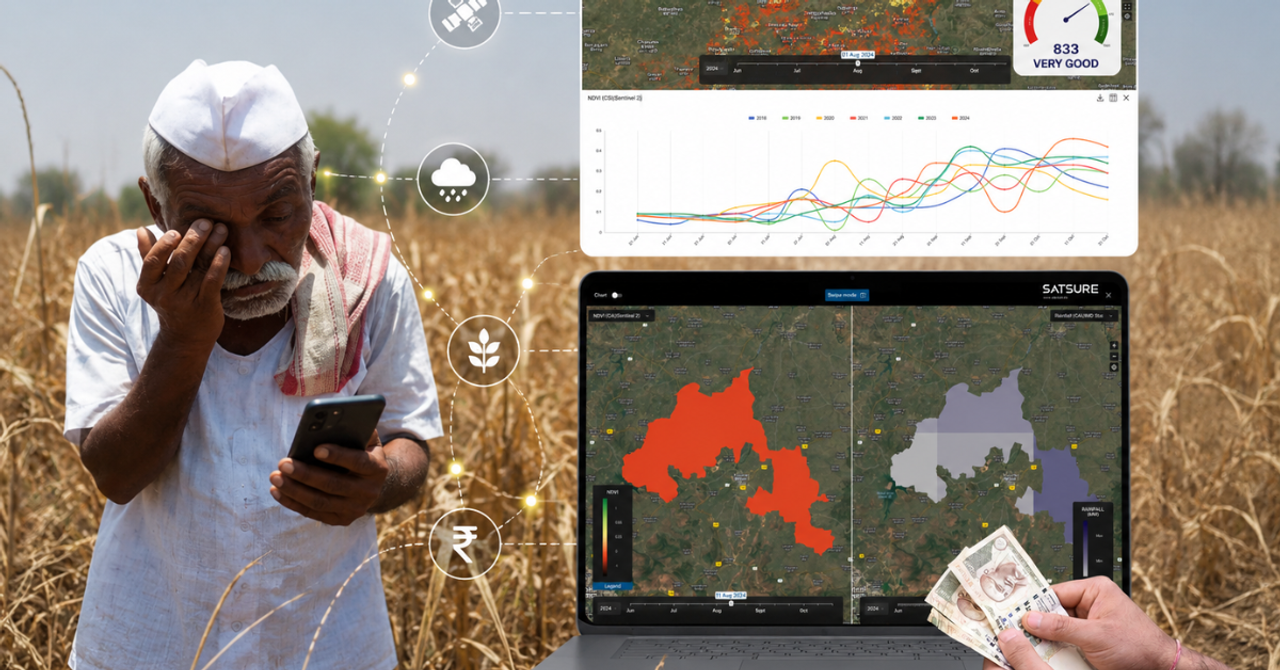
Satellite technology is transforming agricultural lending in India by enabling loan approvals in minutes rather than weeks. By integrating satellite imagery with artificial intelligence (AI), lenders gain real-time insights into farm health, crop patterns, and environmental conditions, allowing for faster and fairer credit decisions. This advancement is critical for supporting millions of farmers who previously faced barriers to accessing formal credit.
A New Perspective on Agricultural Lending
Traditionally, assessing a farmer’s eligibility for credit involved submitting extensive paperwork and sometimes time-consuming field visits. Decisions were often based on static documents and limited observations, leaving many small and marginal farmers without suitable financial support. According to India’s Ministry of Finance Economic Survey 2024–25, agriculture and allied sectors contribute nearly 16% to the country’s GDP and sustain 46.1% of the population. Despite this, about 85% of farmers struggle to obtain loans aligned with their needs, and over 150 million farmers lack access to formal credit.
Satellite data now provides lenders with detailed information about crop type, health, and irrigation status. This approach enables a data-driven evaluation of farmland, reducing the reliance on traditional paperwork and guesswork.
The SatSure Innovation
Founded in Bengaluru in 2017 by Prateep Basu, a former ISRO propulsion engineer, and Rashmit Singh Sukhmani, a former ISRO remote sensing scientist, SatSure leverages satellite imagery and AI to address real-world challenges in agriculture, climate resilience, and financial services.
In the agricultural lending domain, SatSure’s platform analyzes diverse factors including crop types, sowing and harvesting timelines, crop health, and yield trends. It also incorporates climate variables such as rainfall, temperature, groundwater levels, and air quality to identify risks to production.
In addition to farm-specific data, the platform integrates socio-economic indicators—road density, market accessibility, rail connectivity, population growth, and rural prosperity metrics—providing lenders a comprehensive understanding of credit potential in rural areas.
Digitizing Farms to Accelerate Credit
SatSure creates digital twins of farms that track crop conditions across Kharif, Rabi, and summer seasons over multiple years. This system generates a farm-level risk score, detailed in the proprietary SatSource Report.
“The use of satellite-based data enables loan processing to be completed in under an hour, a dramatic reduction from the traditional 30-day timeline, thereby expanding credit access to previously underserved farmers.”
By streamlining loan assessments and enabling same-day disbursals through Straight Through Processing, SatSure enhances financial inclusion. While SatSure itself does not provide loans directly, it partners with government bodies and financial institutions in a B2B2C or B2G2C model to facilitate lending.
Bankers utilize SatSure’s reports to answer crucial questions regarding farmland usage, crop health, and irrigation availability, reducing uncertainty and accelerating approvals.
Significant Impact Across India
To date, SatSure has analyzed over 1.5 million farms and monitored nearly 195,000 villages, helping improve loan decision-making and efficiency across credit cycles. Pricing and implementation depend on factors such as portfolio size, geographic scope, and system integration complexity.
Transforming Loan Timelines
Traditional agricultural loan assessments took 15 to 30 days, involving multiple verification steps. The integration of satellite data has shortened this to less than an hour, a critical advantage in farming where timing is essential for sowing, cultivation, and harvesting.
Faster credit access enables farmers to make timely agricultural decisions, increasing productivity and allowing inclusion of farmers who were previously excluded from formal lending.
Expanding Beyond Credit: Managing Climate Risk
Climate variability poses growing challenges for agriculture. In the first nine months of 2025, extreme weather affected 9.47 million hectares of cropland, a significant increase from 1.84 million hectares in 2022.
Satellite data that supports credit risk assessment also provides detailed climate risk tracking. This facilitates portfolio monitoring, early detection of seasonal stress, and integration with crop insurance programs.
Agriculture, forestry, and land use account for approximately 10% to 22% of global greenhouse gas emissions, making sustainable agricultural practices essential for meeting the United Nations Sustainable Development Goals related to hunger, climate action, and life on land.
Partnerships such as SatSure’s collaboration with the Reserve Bank Innovation Hub (RBIH) aim to address systemic challenges within India’s financial ecosystem.
A Data-Driven Future for Agriculture Finance
The evolving use of satellite technology enriches lending decisions by complementing traditional knowledge with objective, timely data. As adoption grows, loan approvals will increasingly rely on accurate representations of farm conditions rather than assumptions, fostering greater equity and efficiency in agricultural finance.