









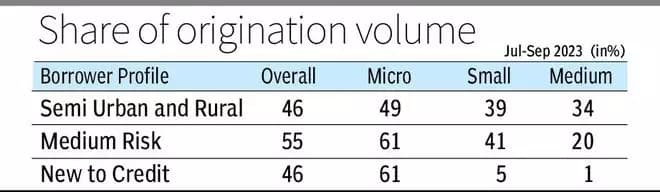
In the latest data released, it has been revealed that semi-urban and rural regions have accounted for a significant 46% of MSME loan originations during Q3 FY24. Within this segment, micro-enterprises made up 49% of the loans, while small enterprises comprised 39%.
This surge in loan originations has been attributed to the overall improvement in credit profiles of MSMEs, as highlighted in the quarterly MSME Pulse Report by TransUnion CIBIL and SIDBI. The report indicates a reduction in the share of high-risk MSMEs from 15% to 13% over the past year, with medium-risk MSMEs dominating at 55%.
- Also read: Policy interventions needed to give MSMEs a boost
Despite the conclusion of the Emergency Credit Line Guarantee Scheme (ECLGS), lending to the MSME sector has continued to grow in the first half of FY2024. Sivasubramanian Ramann, Chairman and MD of SIDBI, emphasized the role of technology in facilitating this growth.
The total value of new MSME credit originations stood at ₹2.4-lakh crore, with small enterprises capturing the largest share at 42%. The MSME loan portfolio for the sector has seen an 11% year-on-year growth, reaching ₹28.2-lakh crore across 80 lakh MSME entities as of September 2023.
According to the report, there has been a notable increase in demand for commercial loans, which saw a 29% year-on-year growth. This surge in demand has been complemented by a 20% year-on-year increase in supply volumes, indicating a positive trend in lender confidence.
Delinquencies within the MSME sector have shown improvement, with overall balance-level delinquencies dropping to 2.3% from 3.0% compared to the previous year.
- Also read: RBI mandates key fact statement for retail, MSME loans
Delinquency rate
Rajesh Kumar, MD and CEO of TransUnion CIBIL, noted, “MSME portfolio performance improved significantly in the recent quarter, with delinquency rates witnessing a decline. The quarter ending September 2023 recorded the lowest delinquency rate in the past two years.”
The report also highlighted that loan originations from major states such as Maharashtra, Gujarat, Delhi, Tamil Nadu, and Uttar Pradesh contributed significantly, representing 47.2% of the total origination value. Uttar Pradesh and Tamil Nadu, in particular, demonstrated high growth rates.
On a sectoral level, manufacturing accounted for the largest share of credit output at 37% in terms of the value of sanctioned loans. The textiles sector emerged as the top contributor within the sub-sectors, with a focus on medium entities primarily serviced by private banks.
The ‘trades’ sector followed closely, comprising 28% of the loan value and dominating in terms of volume. Manufacturing held a share of 25% in the number of loans sanctioned.
![[object Object]](/_next/image?url=https%3A%2F%2Fcms.msmestory.com%2Fwp-content%2Fuploads%2F2026%2F08%2Fog-23.webp&w=3840&q=75)
![[object Object]](/_next/image?url=https%3A%2F%2Fcms.msmestory.com%2Fwp-content%2Fuploads%2F2026%2F08%2Fog-43.jpg&w=3840&q=75)
![[object Object]](/_next/image?url=https%3A%2F%2Fcms.msmestory.com%2Fwp-content%2Fuploads%2F2026%2F08%2Fog-9.png&w=3840&q=75)
![[object Object]](/_next/image?url=https%3A%2F%2Fcms.msmestory.com%2Fwp-content%2Fuploads%2F2026%2F08%2Fog-13.jpg&w=3840&q=75)
![[object Object]](/_next/image?url=https%3A%2F%2Fcms.msmestory.com%2Fwp-content%2Fuploads%2F2026%2F08%2Fog-2.png&w=3840&q=75)