






The Reserve Bank of India, in partnership with NPCI International Payments (NIPL), is set to embark on a journey to expand the Unified Payments Interface (UPI) to 20 countries by the financial year 2029, as highlighted in the central bank’s annual report for FY24.
Recognized as the largest retail payment system in terms of transaction volume, the continuous innovations in UPI have contributed to its enhanced usability and convenience.
Some of the notable features offered by UPI include UPI123Pay, UPI Lite on-device wallet, integration of RuPay credit cards with UPI, and the facilitation of mandates with single-block-and-multiple-debits. Additionally, new features such as conversational payments, offline transactions via near field communication (NFC) technology, and pre-sanctioned credit lines from banks were introduced during FY24.
In its pursuit of global connectivity, the central bank will also explore opportunities for establishing multilateral linkages and collaborations of the Fast Payment System (FPS) with regions like the European Union and the South Asian Association for Regional Cooperation (SAARC).
Exploring New Frontiers
Aside from expanding the geographical reach of UPI, another key focus area will be the exploration of alternative risk-based authentication mechanisms. Leveraging technologies such as behavioural biometrics, location/historical payment data, digital tokens, and in-app notifications, there is a shift away from the traditional SMS-based one-time password (OTP) as an additional factor of authentication (AFA).
The RBI envisions integrating real-time payee name validation as a precursor to fund transfers, acknowledging the availability of innovative solutions to combat fraud and streamline payment processes.
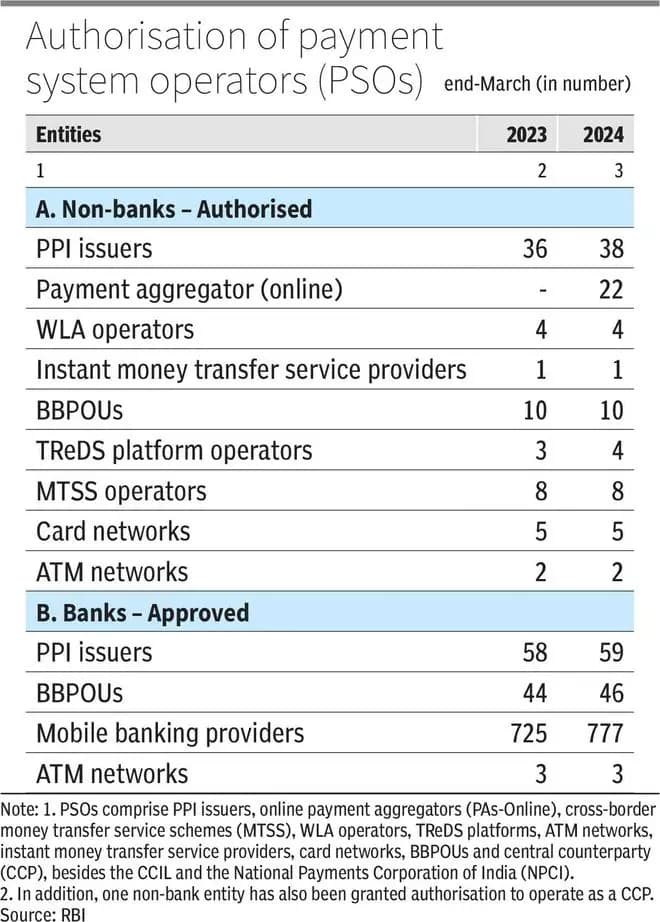
Furthermore, in FY24, the central bank granted authorization to 22 online payment aggregators (PAs), two non-bank Prepaid Payment Instrument (PPI) issuers, and a Trade Receivables Discounting System (TReDS) platform operator. It also provided in-principle authorization to several other online PAs, PPIs, a white label ATM (WLA) operator, and a TReDS platform operator. Approvals were also extended to a bank for PPI issuance, two banks for functioning as Bharat Bill Payment Operating Units (BBPOUs), and 52 banks for offering mobile banking services to their clientele.
![[object Object]](/_next/image?url=https%3A%2F%2Fcms.msmestory.com%2Fwp-content%2Fuploads%2F2026%2F08%2Fog-23.webp&w=3840&q=75)
![[object Object]](/_next/image?url=https%3A%2F%2Fcms.msmestory.com%2Fwp-content%2Fuploads%2F2026%2F08%2Fog-43.jpg&w=3840&q=75)
![[object Object]](/_next/image?url=https%3A%2F%2Fcms.msmestory.com%2Fwp-content%2Fuploads%2F2026%2F08%2Fog-9.png&w=3840&q=75)
![[object Object]](/_next/image?url=https%3A%2F%2Fcms.msmestory.com%2Fwp-content%2Fuploads%2F2026%2F08%2Fog-13.jpg&w=3840&q=75)
![[object Object]](/_next/image?url=https%3A%2F%2Fcms.msmestory.com%2Fwp-content%2Fuploads%2F2026%2F08%2Fog-2.png&w=3840&q=75)