









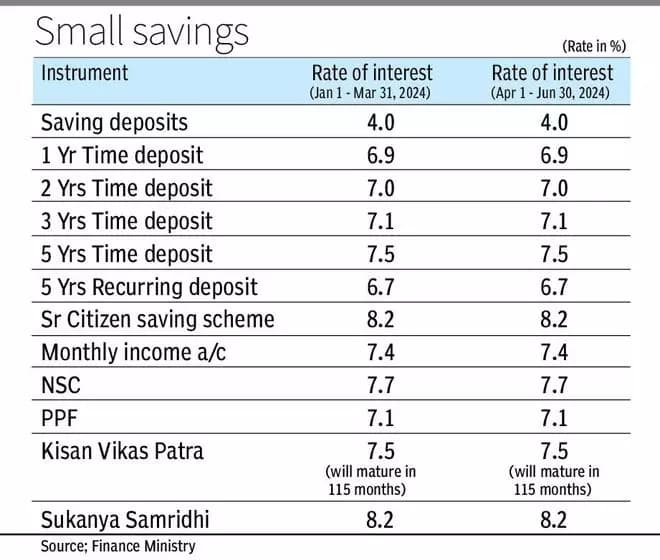
The Finance Ministry recently announced that there will be no changes in the interest rates of small saving schemes like the Public Provident Fund (PPF) and Sukanya Samridhi for the upcoming April-June quarter.
During this period, the interest rate on PPF will remain at 7.1 per cent, while the rate on the Sukanya Samridhi scheme will stay at 8.2 per cent.
The basket of small savings schemes includes 12 different instruments such as the National Saving Certificate (NSC), Public Provident Fund (PPF), Kisan Vikas Patra (KVP), and Sukanya Samridhi Scheme.
Interest rate resetting
It is important to note that the government typically resets the interest rates on these schemes at the start of each quarter. While the theoretical approach has been to base the resetting on the yields of government securities with a spread for senior citizens, the actual changes in interest rates often take into account various other factors, including political considerations.
Overall, the decision to maintain the current interest rates reflects the government’s stance on stability and continuity in the small saving schemes sector.
Table of Contents
- Interest rates remain unchanged
- Overview of small savings schemes
- Insights into interest rate resetting
Interest rates remain unchanged
The Finance Ministry has confirmed that the interest rates on popular small saving schemes like PPF and Sukanya Samridhi will not see any modifications in the upcoming April-June quarter.
Overview of small savings schemes
Small savings schemes play a crucial role in encouraging individuals to save and invest for the future. The basket of such schemes includes a diverse range of options catering to different needs and preferences.
Instruments like the National Saving Certificate, Public Provident Fund, Kisan Vikas Patra, and Sukanya Samridhi Scheme offer attractive interest rates and tax benefits to investors.
Insights into interest rate resetting
While the official resetting mechanism is based on the yields of government securities, the actual rate changes can be influenced by various economic and non-economic factors.
Factors such as inflation, market conditions, and political considerations often play a role in determining the interest rates on small saving schemes, ensuring a delicate balance between investor returns and government fiscal objectives.
Published on March 8, 2024
![[object Object]](/_next/image?url=https%3A%2F%2Fcms.msmestory.com%2Fwp-content%2Fuploads%2F2026%2F08%2Fog-23.webp&w=3840&q=75)
![[object Object]](/_next/image?url=https%3A%2F%2Fcms.msmestory.com%2Fwp-content%2Fuploads%2F2026%2F08%2Fog-43.jpg&w=3840&q=75)
![[object Object]](/_next/image?url=https%3A%2F%2Fcms.msmestory.com%2Fwp-content%2Fuploads%2F2026%2F08%2Fog-9.png&w=3840&q=75)
![[object Object]](/_next/image?url=https%3A%2F%2Fcms.msmestory.com%2Fwp-content%2Fuploads%2F2026%2F08%2Fog-13.jpg&w=3840&q=75)
![[object Object]](/_next/image?url=https%3A%2F%2Fcms.msmestory.com%2Fwp-content%2Fuploads%2F2026%2F08%2Fog-2.png&w=3840&q=75)