









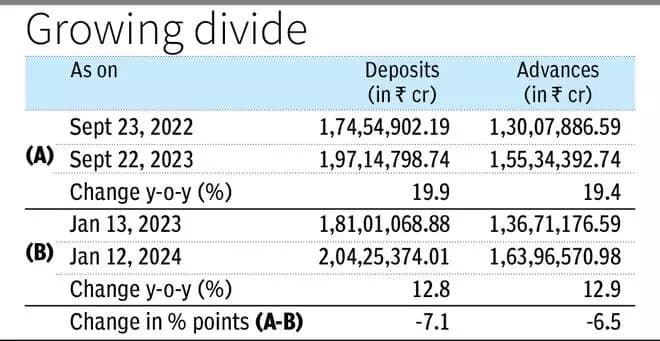
The Reserve Bank of India (RBI) has reported a widening gap between credit and deposit growth in the first fortnight of January 2024 compared to the last fortnight of September 2023. Despite credit growth continuing to outpace deposit growth on a year-on-year basis, the disparity between the two has increased, according to RBI data.
Summary:
As of January 12, 2024, credit growth stood at 19.93% year-on-year, while deposit growth was recorded at 12.84%, resulting in a gap of 7.09 percentage points. In contrast, during the last fortnight of September 2023, the variance between credit and deposit growth was relatively lower at 6.48 percentage points.
Key Highlights:
- Bank credit increased by ₹10,277 crore, while deposits declined by ₹98,848 crore during the reporting fortnight.
- Deposit growth lags behind credit growth due to other investment avenues offering higher returns.
- The incremental credit-deposit (CD) ratio has decreased to 96.2% by December 2023 from a peak of 133.8% in November 2022.
- Rising interest rates have enhanced banks’ net interest margins (NIM), leading to improved profitability.
- However, as interest rates peak, banks’ profitability may face challenges from valuation losses and risks to asset quality.
The RBI’s Financial Stability Report (FSR) highlights the cyclical nature of credit and deposit growth convergence, with short-term divergences ultimately rectifying themselves. The current scenario reflects a trend where credit growth surpasses deposit growth, driven by robust lending activities amidst sustained demand.
Market experts attribute the reduced deposit growth to the allure of alternative investment options such as non-convertible debentures and equity markets offering more attractive returns compared to traditional bank deposits.
Outlook and Implications:
While the current interest rate environment has favored banks by bolstering their NIM, the imminent peak in the rate cycle poses challenges that could impact banks’ profitability in the future. Asset quality concerns, coupled with moderating credit growth, may present hurdles for the banking sector going forward.
![[object Object]](/_next/image?url=https%3A%2F%2Fcms.msmestory.com%2Fwp-content%2Fuploads%2F2026%2F08%2Fog-23.webp&w=3840&q=75)
![[object Object]](/_next/image?url=https%3A%2F%2Fcms.msmestory.com%2Fwp-content%2Fuploads%2F2026%2F08%2Fog-43.jpg&w=3840&q=75)
![[object Object]](/_next/image?url=https%3A%2F%2Fcms.msmestory.com%2Fwp-content%2Fuploads%2F2026%2F08%2Fog-9.png&w=3840&q=75)
![[object Object]](/_next/image?url=https%3A%2F%2Fcms.msmestory.com%2Fwp-content%2Fuploads%2F2026%2F08%2Fog-13.jpg&w=3840&q=75)
![[object Object]](/_next/image?url=https%3A%2F%2Fcms.msmestory.com%2Fwp-content%2Fuploads%2F2026%2F08%2Fog-2.png&w=3840&q=75)