









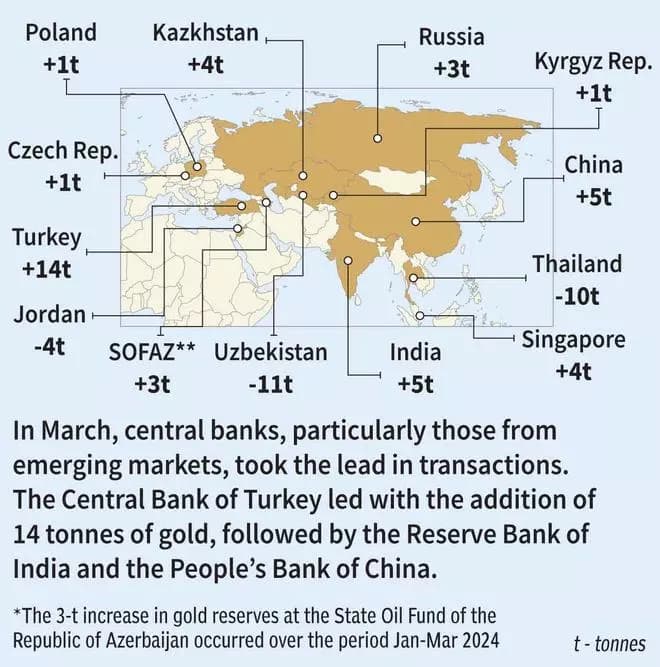
Central banks around the world have maintained their momentum in acquiring gold, with a total addition of 290 tonnes in the first quarter of the year, despite a surge in prices impacting consumer demand.
Table of Contents
- Central Banks’ Significant Contribution to Gold Demand
- Breakdown of Gold Purchases by Various Countries
- Increasing Gold Reserves in Forex Holdings
- Gold Price Trends and Influence of Central Bank Actions
- Strategic Implications for Central Banks
Central Banks’ Significant Contribution to Gold Demand
Central banks made up 23% of the overall gold demand in the March quarter, totaling 1,238 tonnes. This consistent interest in the precious metal has been a notable trend over the past few years.
Breakdown of Gold Purchases by Various Countries
During the March quarter, countries like India, Turkey, and China increased their gold reserves significantly. India purchased 19 tonnes, while the Central Bank of Turkey and the People’s Bank of China added 30 tonnes and 29 tonnes, respectively.
Increasing Gold Reserves in Forex Holdings
Central banks, including the Reserve Bank of India (RBI), have been actively diversifying their forex reserves by adding gold. The RBI, in particular, boosted its gold holdings by 200 tonnes in 2009 during the global financial crisis.
Gold Price Trends and Influence of Central Bank Actions
The recent surge in gold prices, reaching $2,070 ($1,860) per ounce in the March quarter, has been partly fueled by central bank purchases. This move is seen as a hedge by central banks against geo-political uncertainties and global economic slowdown.
Strategic Implications for Central Banks
Experts like Madan Sabnavis from Bank of Baroda emphasize the strategic nature of central banks’ gold acquisitions. Gold, being a hedge against the weakening dollar, provides stability to forex reserves and serves as a prudent financial decision amidst market volatilities.
Sachin Jain, Regional CEO India at the World Gold Council, highlights that the central banks’ gold purchases are not solely driven by price trends. The acquisitions signal a broader strategy to diversify reserves and manage risks effectively.
![[object Object]](/_next/image?url=https%3A%2F%2Fcms.msmestory.com%2Fwp-content%2Fuploads%2F2026%2F08%2Fog-23.webp&w=3840&q=75)
![[object Object]](/_next/image?url=https%3A%2F%2Fcms.msmestory.com%2Fwp-content%2Fuploads%2F2026%2F08%2Fog-43.jpg&w=3840&q=75)
![[object Object]](/_next/image?url=https%3A%2F%2Fcms.msmestory.com%2Fwp-content%2Fuploads%2F2026%2F08%2Fog-9.png&w=3840&q=75)
![[object Object]](/_next/image?url=https%3A%2F%2Fcms.msmestory.com%2Fwp-content%2Fuploads%2F2026%2F08%2Fog-13.jpg&w=3840&q=75)
![[object Object]](/_next/image?url=https%3A%2F%2Fcms.msmestory.com%2Fwp-content%2Fuploads%2F2026%2F08%2Fog-2.png&w=3840&q=75)