









Amidst the evolving financial landscape, the anticipated moderation in deposit growth for banks in FY25 to 12-13 per cent from 13.8 per cent in FY24 is projected to intensify the competition for deposit accretion. This expected shift highlights the growing importance of low-cost current account savings account (CASA) deposits in the banking sector.
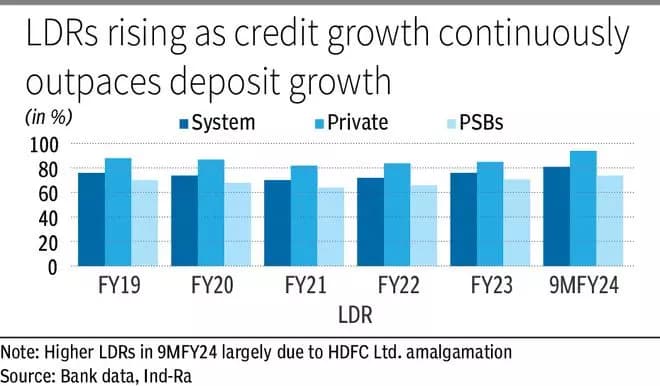
Although there was a notable improvement in deposit growth to 12.5 per cent in Q3 FY24 from 9.6 per cent in FY23, the pace still lags behind the system credit growth, standing at around 16.1 per cent. The system loan to deposit ratio (LDR) has surged to 81 per cent, marking a five-year high. This trend is pushing banks towards a higher reliance on bulk deposits, especially if the growth in granular deposits remains constrained.
Table of Contents
Sector Outlook
India Ratings has maintained a ‘neutral’ outlook on the banking sector for FY25. The credit growth forecast for FY24 has been revised to 20.5 per cent (inclusive of the impact of HDFC merger). This growth is primarily being driven by sustained expansion in retail, NBFCs, other services, and government/public sector units.
Looking ahead to FY25, credit growth is expected to moderate to 15 per cent, albeit with a change in the portfolio mix due to a slowdown in lending to NBFCs and the retail sector. This change is likely to be offset by a revival in private capex, benefiting corporate credit growth.
One key observation is the shift in the deposit mix due to an increase in policy rates and the augmented rates on term deposits. This transformation has resulted in a decline in the CASA ratio for the system, excluding the impact of the HDFC amalgamation. However, there is an anticipation that some of these funds might flow back to CASA balances once the interest rate cycle begins to reverse in H2 FY25, thereby providing support to CASA ratios.
PSU banks seem to have an advantage in terms of deposits, boasting an average LDR of around 65 per cent, significantly lower than the 82-83 per cent recorded by private banks. As a consequence, select private banks are offering higher interest rates for savings deposits. Conversely, PSU banks could witness substantial loan growth and profitability without the immediate necessity to expand deposits proportionately.
FY25 Inflection Point
Furthermore, the significant enhancement in banks’ financial metrics observed during FY21-FY24 is expected to encounter an inflection point in FY25. The consistent reduction in net slippages and the downward trend in credit costs during FY24 is unlikely to be sustainable. There is a projection that net slippages, at 44 bps, and credit costs, at 72 bps during FY24, are set to rise as FY25 unfolds.
As quoted by Karan Gupta, Head and Director Financial Institutions, India Ratings, “The improving return on assets over FY21-FY24 is likely to reach an inflection point with some pressure on margins and credit costs reaching multi-year lows.”
SEO Focus Keyword: Deposit Growth Moderation in FY25
![[object Object]](/_next/image?url=https%3A%2F%2Fcms.msmestory.com%2Fwp-content%2Fuploads%2F2026%2F08%2Fog-23.webp&w=3840&q=75)
![[object Object]](/_next/image?url=https%3A%2F%2Fcms.msmestory.com%2Fwp-content%2Fuploads%2F2026%2F08%2Fog-43.jpg&w=3840&q=75)
![[object Object]](/_next/image?url=https%3A%2F%2Fcms.msmestory.com%2Fwp-content%2Fuploads%2F2026%2F08%2Fog-9.png&w=3840&q=75)
![[object Object]](/_next/image?url=https%3A%2F%2Fcms.msmestory.com%2Fwp-content%2Fuploads%2F2026%2F08%2Fog-13.jpg&w=3840&q=75)
![[object Object]](/_next/image?url=https%3A%2F%2Fcms.msmestory.com%2Fwp-content%2Fuploads%2F2026%2F08%2Fog-2.png&w=3840&q=75)