




Introduction
In India, dairy farming plays a critical role in supporting millions of livelihoods, yet small-scale farmers often face significant challenges in managing cattle health and reproduction effectively. The Ayushman Cowfit, an AI-driven smart collar developed specifically for Indian cattle, offers a transformative solution by enabling early detection of illness and accurate monitoring of heat cycles, helping farmers prevent costly income losses and optimize milk production.
Challenges on a Gujarat Dairy Farm
For six months, Janak Patel struggled with losses on his dairy farm in Gujarat. His buffalo went into heat without displaying the usual signs farmers rely on. By the time Patel noticed the short fertile window had opened, it had already closed, resulting in another month of feed costs without pregnancy or milk production.
Introducing the Ayushman Cowfit
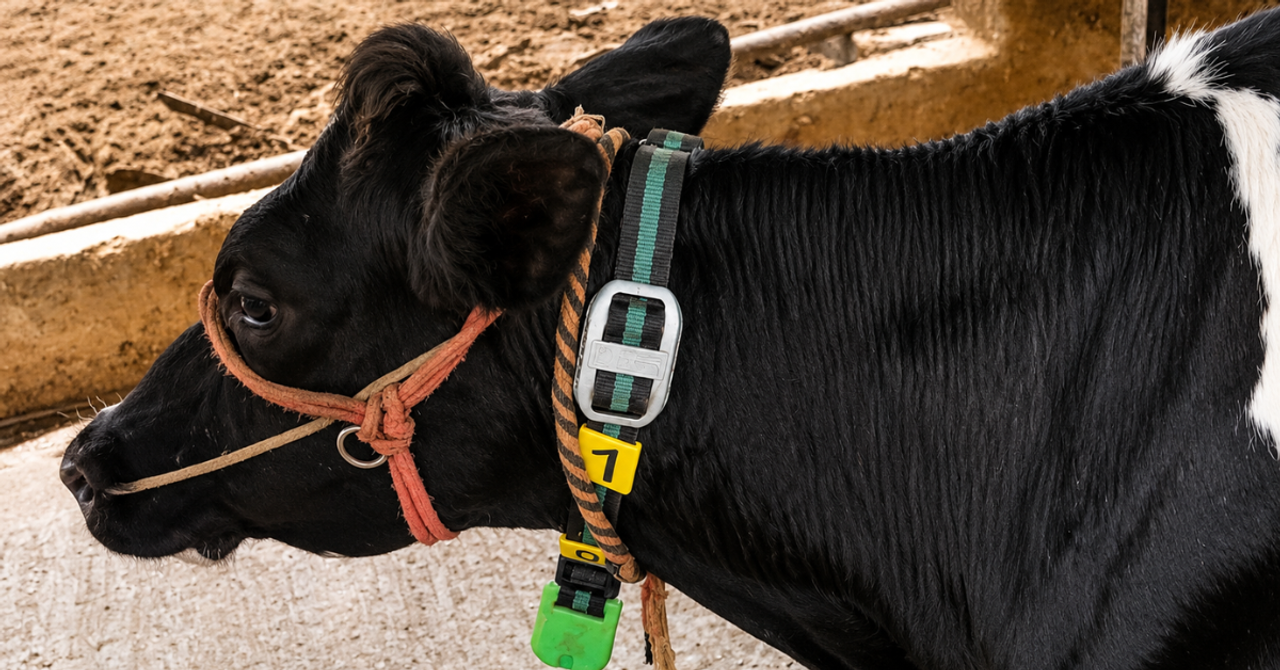
Patel’s situation changed when he began using the Ayushman Cowfit, a fluorescent, sealed collar worn around a cow’s neck. This smart device simultaneously tracks multiple health indicators such as skin temperature, jaw movement, activity levels, and sleep duration.
Within days, the collar alerted Patel to a heat cycle he had been missing. “Thanks to the AI belt, we noticed a cow’s silent heat that we had been missing for six months,” Patel said. This timely alert enabled a prompt artificial insemination (AI), with detailed AI tracking proving invaluable for his dairy operations.
A Solution for Indian Farmers
The challenges Patel encountered reflect the widespread issues faced by Indian farmers. Pune-based Areete Business Solutions (ABS) was established to address these, providing technology tailored specifically for India’s small-scale dairy farmers.
The Cost of Missing a Heat Cycle
India is the world’s largest milk producer, accounting for approximately 25% of global milk output. The 20th Livestock Census reports over 300 million bovines in India, including 125.75 million milch cows and buffalo. Livestock farming contributes 5.5% to the Indian economy and supports over 80 million farmers.
Small farmers owning between five and 15 animals face inefficiencies that quietly reduce income each year. One major loss arises from missing a cow’s heat cycle, which lasts roughly 18 hours every 21 to 25 days. The optimal insemination window is only eight hours within this period.
Missing this window often costs farmers a month’s worth of feed expenditure without corresponding milk production, with losses ranging from Rs 8,000 to Rs 15,000. The scarcity of AI agents compounds this problem, with an ideal ratio of one AI agent per 3,000 to 5,000 cattle contrasting sharply against the current ratio of one per 15,000 to 20,000 cattle.
AI agents frequently serve up to 150 villages, traveling long distances while transporting semen in liquid nitrogen that must be thawed on site. These logistical challenges make it difficult to capitalize on the short fertile window.
Health Monitoring Challenges
Beyond reproduction, monitoring cattle health remains problematic. Many small farmers cannot detect illness until visible symptoms appear, at which stage treatment costs escalate and productivity declines.
Founders Committed to Agriculture
V S Shridhar, with extensive experience in technology sectors at IBM and Tata Group, aspired to impact agriculture meaningfully. “My heart wanted to do something for the agriculture industry,” he said. “Technology should reach the mass market and touch every farmer if possible.”
Shridhar joined forces with Srinivas Subramanian, founder of Areete Business Solutions (founded in 2021), becoming co-founder and Joint Managing Director. They recognized the need for an affordable and practical cattle health monitoring device tailored for Indian farmers.
Existing international cattle wearables, priced between Rs 15,000 and Rs 18,000, require fiber or wired connections and cater to large farms in Europe or North America. They are unsuitable for Indian cattle breeds or tethered animals commonly found in India. Shridhar observed, “When we looked at India, there was no one doing it.”
Designing a Collar for Indian Farms
The Ayushman Cowfit features an adjustable neck belt sourced from Ahmedabad, fitting all cattle sizes from buffalo to smaller Indian breeds. Its sealed enclosure protects four sensors against dust, water, and heat.
Perfecting the hardware took five design iterations, overcoming issues like water seepage. Manufacturing is entirely Indian, with electronics from Bangalore, belts from Ahmedabad, and weighted components from Kolhapur.
The collar lasts five to seven years. Farmers do not recharge it themselves; ABS staff replace batteries every three years to manage the needs of farms with dozens of cattle.
Impact on Milk Production
At Rohini Dairy Farm in Bagalkot, Karnataka, rumination data sourced from the device enabled adjustments to feed and supplements, increasing milk production from 280 to 340 litres per day.
Individual Health Tracking
Ayushman Cowfit differentiates itself by learning each animal’s individual health baseline during the first two weeks. It then tracks eating hours, activity, sleep, and skin temperature, raising alerts based on deviations from the animal’s personal patterns rather than herd averages.
“You and I are different ages—my blood pressure and yours should not be the same standard,” explained Shridhar. This personalized approach is especially effective for tied animals.
The collar begins monitoring from the moment it is worn, encouraging farmers to check updates daily, similar to tracking the weather forecast.
Swati Dhobale from Pune noted, “After installing the Ayushman Cowfit, I can monitor every heat cycle in my cows without fail. It has greatly improved reproductive success.”
Early Sickness Detection
The collar can identify illness approximately two days before visible symptoms appear by detecting behavior changes such as reduced eating, increased sleep, and decreased movement.
Nanda Dhobale from Maharashtra initially doubted the technology. However, following an early health alert, a veterinarian confirmed illness in one of her HF crossbreed cows. Early medication restored the animal’s health, keeping treatment costs low and preventing productivity loss.
Similarly, Vijayakumar Pawar from Satara reported that after two failed inseminations and Rs 10,000 spent on sorted semen, the Cowfit collar enabled accurate heat cycle tracking. The third insemination resulted in pregnancy. “The device cost was recovered within a month,” he said.
Reaching Farms and Institutions
ABS currently serves nearly 1,000 farms across Maharashtra, Gujarat, and Punjab, with several large cooperatives in Gujarat using the device, particularly for buffalo heat detection.
The Lucknow Raj Bhavan Gaushala, a cow shelter managing 17 devices, reports an 85% accuracy rate. Their data is submitted directly to the Chief Minister of Uttar Pradesh.
Punjab farmer Gurlad Singh, managing over 150 cows, stated, “Managing the heat and health of my 150-plus cows is effortless with Ayushman Cowfit.”
ABS also offers a virtual care team that proactively contacts farmers in Punjabi, Gujarati, and Marathi when alerts indicate missed actions or health issues. The device supports remote installation and is already in use in the Andaman and Nicobar Islands.
A Vision for Small Farmers and Policy Impact
ABS won the National Startup Award in Innovation in January 2026, along with the Maharashtra State Innovation Award, ICAR certification, and the Torch Award from Thailand.
However, the founders emphasize aiding the 95% of Indian dairy farmers who are smallholders. Maharashtra’s government subsidy program for farm modernization may facilitate wider adoption of the device.
The long-term vision includes creating a live health map of India’s cattle, enabling early disease detection and supporting policymakers with detailed data to improve livestock development where most needed.
Shridhar said, “We want to provide policymakers with region-wise data on cattle health to drive better livestock outcomes.”
Priced at Rs 6,500 per device—an investment that pays for itself by preventing a single missed heat cycle—the technology’s economics are compelling. The main challenge is reaching India’s vast, scattered small dairy farmers. ABS is progressing steadily in this endeavor, one smart collar at a time.
Images courtesy of Areete Business Solutions.
Author: Avantika Krishna