
[ad_1]
It was 2 pm one afternoon in 2021 when Srishti, a Class 4 student, returned from school and rushed to find her mother. “How can a ship float on water if it’s made of metal?” she asked the bemused Sonali. Science class at school that day was all about exploring the nature of liquids and their density. Srishti’s teacher mentioned a higher density possessed by metals rendered them “heavier” than water.
“So, the ship should sink, right?” Srishti persisted.
A valid doubt thought Sonali.
Fortunately for Srishti, her mother had all the answers. With a PhD in physics from IIT Delhi and 12 years of brainstorming on photonics with some of the best minds in science, Dr Sonali Dasgupta was equipped with the expertise to answer all the eight-year-old’s innocent doubts. And this time was no different.
The little girl watched with bated breath as her mother conjured yet another experiment. This was usual in the Dasgupta household.
A concept that was a bullet point in the textbook came to life as Sonali fetched some aluminium foil from the kitchen, and bent it into a hollow boat-like shape which she then placed in a bucket of water. It floated!

Where innovation is always a guest at the table
Sharing this anecdote with msmestory gets Sonali reminiscent of all the times she and Srishti have bonded over experiments. The lockdown was one of the most important phases.
“It was a pivotal point in my life in many ways,” shares Sonali. Not only did the Bengaluru mother launch her hands-on learning ecosystem STEMonsters during the second wave of the pandemic in 2021, but it was also the time she made a conscious decision to return to India from the UK where she was currently working.
“It was a professional call,” she says.
In hindsight, Sonali says it shaped many of her decisions positively. Her role as a scientist from 2007 to 2019 provided her with the scientific acumen she now fuses into every session at STEMonsters.
When Srishti was younger, Sonali would often get model samples from the lab or take her daughter to work. The lockdown cut off these avenues of learning. So, instead, Sonali brought the lab to their home to instil a sense of curiosity in her child, one that she herself had harnessed all these years.
While the world was “stuck” amidst the pandemic, this duo ensured the learning never stopped. A routine day witnessed them breathing life into different concepts, where “learning by doing” was the mantra.
“We learnt about the different properties of water, and I showed Srishti how absorbent materials differ from non-absorbent ones. I got her thinking about why a TV screen is black and not white, and why a phone does not get a signal when placed in the microwave,” she informs.
This probing often enthused Srishti to keep learning and to fall in love with science along the way. As the lockdown progressed, Sonali’s videos on WhatsApp stories became more popular, and she was flooded with requests from friends and family to include their kids in the fun.
The parents’ interest confirmed Sonali’s thoughts on how the traditional teaching techniques in schools needed an upgrade. “Often academics in Indian schools do not think beyond definitions. While working in some of the best labs in the world, I was exposed to different approaches and watched how kids were introduced to science. I strongly believe our curriculum is one of the best, but it needs an overhaul in the way we introduce it to children.”

Studying happens at school; learning happens at STEMonsters
“Have you observed how your cocktail at a restaurant is layered with different colours?” Sonali asks me. I answer affirmatively, excited to be let in on some science magic.
“That’s another place where density plays a role,” she carries on. “Srishti and I took a glass bottle and poured liquids like soya sauce, coloured water, raspberry sauce, mustard sauce, etc. in one by one. We got a Rainbow Density Tower.” I am not surprised by Srishti’s enthusiasm for science. Just hearing these concepts explained in relatable ways amazes me.
“This lesson can then be expanded to touch upon how liquids take the shape of the container,” Sonali adds. “You see how everything is interdisciplinary and how so many concepts can be introduced to kids without overwhelming them.”
### Table of Content:
– Introduction
– Where innovation is always a guest at the table
– Studying happens at school; learning happens at STEMonsters
### Introducing STEM Education
The article highlights the journey of Sonali Dasgupta, a scientist, who initiated the STEM educational platform, STEMonsters, for children’s hands-on learning experiences.
### Where Innovation Thrives
Sonali reminisces on the importance of innovation and hands-on learning, especially during the lockdown period, shaping her decision to establish STEMonsters.
### Learning Beyond Textbooks
STEMonsters aims to bridge gaps in traditional teaching methods, instilling curiosity and a sense of wonder in children through practical science and mathematics education.
### The Science Behind Everyday Life
Discover how Sonali and her daughter, Srishti, explored scientific concepts in daily life, encouraging a love for learning through engaging experiments.
### Conclusion
Showcasing the impact of innovative teaching methods and hands-on learning on children’s educational experiences, emphasizing the importance of practical science education.
**SEO Focus Keyword:** STEM Education
STEMonsters: Inspiring Young Minds in Bengaluru
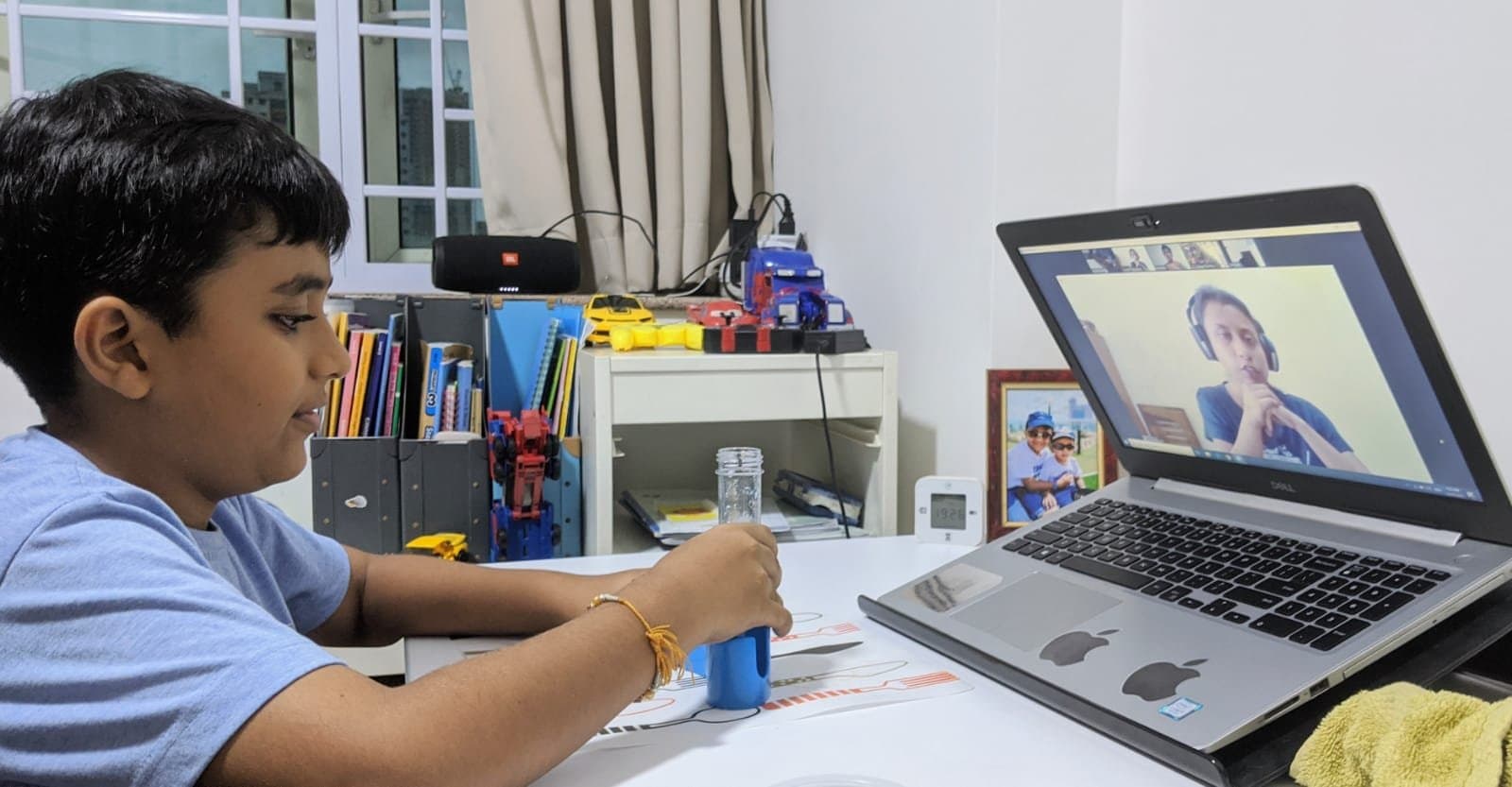
At the STEMonsters office in Bengaluru, innovative experiments are underway to engage kids aged 8 to 14 in the exciting world of science and maths. The ongoing learning program brings together children on Zoom, where they delve into the intricacies of these subjects. Classes are organized to encourage peer learning, with Classes 3 and 4, Classes 5 and 6, and Classes 7, 8, and 9 forming distinct groups.
Interactive Learning Experience
Facilitator Sonali ensures that students not only learn from her but also from each other. Ishani, a Class 6 student, expresses her interest in forensics and her eagerness to unravel mysteries. Similarly, Aryan Kejriwal from Class 5 shares his enthusiasm for the solar system lesson, which involved creating origami stars.

Engaging Sessions
Each session is meticulously planned, starting with experiments, followed by interactive discussions and clarifications to strengthen the understanding of the concepts covered. Sooktha Shastry, a Class 7 student, particularly enjoys the hands-on learning approach. She highlights the space-related experiment featuring the James Webb telescope origami model.
Over 1300 students have benefitted from Sonali’s mentorship, with participants joining from across India, Hong Kong, and Singapore. The program, consisting of 12 sessions, is priced at Rs 6,200.
Empowering Young Minds
When not conducting online classes, Sonali conducts offline workshops at schools, nurturing young minds and fostering curiosity. Witnessing the curiosity mirrored in these students, she feels a sense of fulfillment.
“The circle is complete,” reflects Sonali.
Edited by Pranita Bhat
**SEO Focus Keyword: STEM Education in India**